
The screw press dewatering machine and filter press are not the same. Although both are solid-liquid separation equipment for sludge dewatering, they have essential differences in core dimensions such as working principle, structural design, and operation mode. The screw press dewatering machine is an upgraded product of the filter press.
Differences in Working Principles
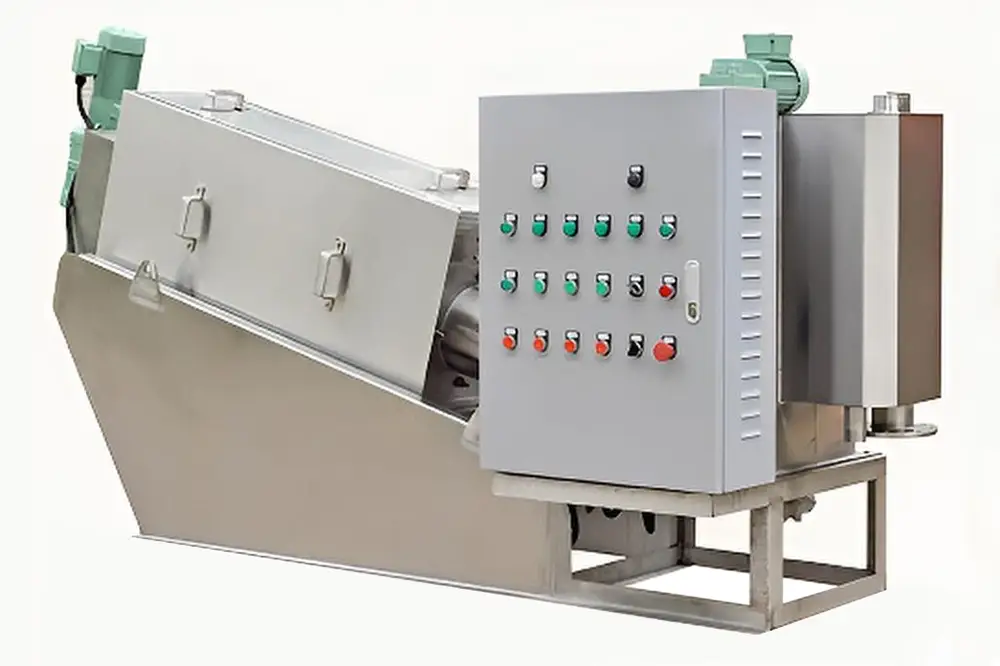
- Screw Press Dewatering Machine: Adopts dynamic continuous dewatering technology. It pushes sludge to move in the gap between fixed rings and moving rings through the rotation of the screw shaft, achieving dewatering by means of the axial pressure of the screw shaft and the shear force between the ring sheets, following the principles of same direction of force and water, and thin-layer dewatering.
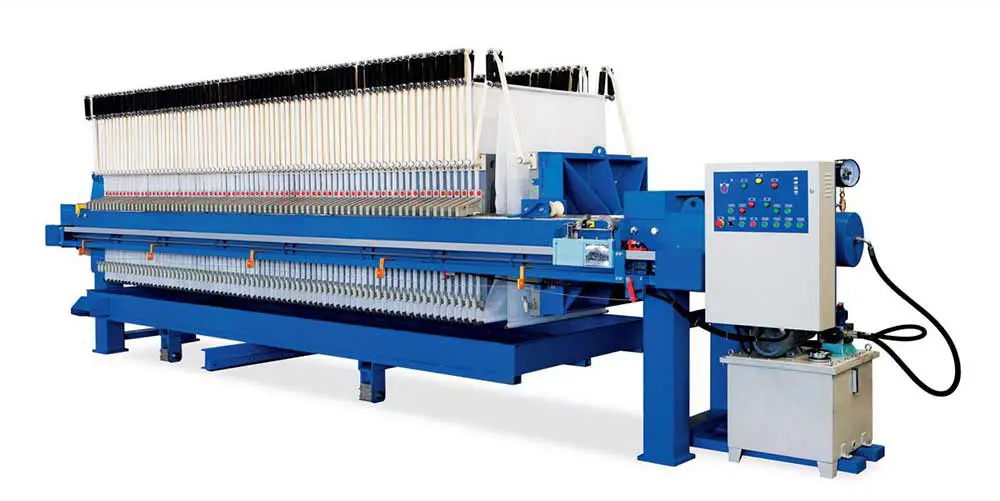
- Filter Press: Uses static high-pressure dewatering technology. It compacts filter plates through a hydraulic system to form a closed filtration chamber. With the help of filter media, the liquid in the sludge is discharged through the filter cloth under pressure to achieve solid-liquid separation.
Differences in Structural Composition
- Screw Press Dewatering Machine: The structure is relatively simple, mainly composed of four parts: electric control box, sludge mixing box, concentration and dewatering body, and liquid collection tank. It has a high degree of integration and a compact body.
- Filter Press: Mainly consists of three parts: frame, clamping mechanism, and filtration mechanism. The structure is complex, the volume is large, and it lacks flexibility.
Differences in Operation Modes
- Screw Press Dewatering Machine: Can realize dynamic continuous operation, integrating feeding, sludge discharge in one go without frequent startup and shutdown. It can also control the dewatering degree by adjusting the rotation speed of the screw shaft, supporting fully automatic unattended operation and even PLC remote control.
- Filter Press: Adopts intermittent operation mode, requiring frequent startup and shutdown. The filter cloth is prone to clogging and needs manual cleaning, so continuous automatic operation cannot be achieved.
Differences in Application Scenarios and Performance
- Screw Press Dewatering Machine: Covers a small area, only 1/3 of that of traditional filter presses. It is suitable for sludge scenarios with small treatment capacity and low solid content, such as municipal sewage treatment plants and food processing wastewater treatment. It is energy-saving, has few wearing parts, and a longer service life.
- Filter Press: Has high dewatering efficiency and lower moisture content of the discharged sludge. It is suitable for scenarios with large treatment capacity and strict requirements on the moisture content of the discharged sludge. However, wearing parts such as filter cloth need to be frequently replaced, resulting in high maintenance costs.
Selection Comparison Between Screw Press Dewatering Machine and Filter Press
The following is a structured comparison table of screw press dewatering machine and filter press in terms of core technical parameters, performance indicators, application scenarios, etc., facilitating quick comparison and selection. It can be directly copied for scheme design, customer communication, or internal filing:
| Comparison Dimension | Screw Press Dewatering Machine | Filter Press (Plate and Frame / Chamber Filter Press) |
|---|---|---|
| Core Working Principle | Screw extrusion + ring sheet shear, dynamic continuous dewatering | Hydraulic compaction of filter plates + filter cloth filtration, static high-pressure intermittent dewatering |
| Structural Features | High integration, composed of electric control box, mixing box, concentration and dewatering body, liquid collection tank, compact volume | Composed of frame, clamping mechanism, filtration mechanism (filter plates + filter cloth), complex structure, large volume |
| Operation Mode | Continuous operation, integrated feeding - concentration - dewatering - sludge discharge, no frequent startup and shutdown | Intermittent operation, requiring "compaction → feeding → filtration → sludge discharge → cleaning" cycle |
| Degree of Automation | High, supports PLC remote control, unattended operation, automatic adjustment of screw rotation speed | Medium-low, some models can automatically compact / discharge sludge, but filter cloth cleaning and sludge transportation require manual assistance |
| Treatment Capacity Range | Small - medium capacity, single unit treatment capacity 5-50 m³/h (sludge solid content 1%-3%) | Medium - large capacity, single unit treatment capacity 10-200 m³/h (sludge solid content 3%-10%) |
| Moisture Content of Discharged Sludge | 75%-85% (conventional working conditions), special models can be reduced to 70%-75% | 60%-75% (high-pressure models can be as low as 55%-60%), more thorough dewatering effect |
| Floor Space | Small, only 1/3-1/5 of that of filter presses, suitable for scenarios with limited space | Large, needs to reserve space for filter plate disassembly and sludge stacking |
| Energy Consumption Level | Low, single unit power 1.5-5.5 kW, low operating cost | High, hydraulic system + feed pump power 10-50 kW, energy consumption is 3-5 times that of screw press dewatering machines |
| Wearing Parts and Maintenance | Few wearing parts (mainly screw shaft wear-resistant sleeves), maintenance cycle 6-12 months, low cost | Many wearing parts (filter cloth, filter plate gaskets), need regular replacement (filter cloth every 3-6 months), high maintenance cost |
| Anti-clogging Capacity | Strong, ring sheet gaps can be automatically cleaned, suitable for sludge containing fibers and fine particles | Weak, filter cloth is prone to clogging, requires frequent flushing, and has high requirements for sludge pretreatment (needing chemical flocculation) |
| Suitable Sludge Types | Municipal sludge, food wastewater sludge, lightly polluted chemical sludge, low solid content sludge (1%-3%) | Industrial high-concentration sludge, mine sludge, printing and dyeing sludge, high solid content sludge (3%-10%) |
| Suitable Scenarios | Small and medium-sized sewage treatment plants, environmental protection engineering supporting facilities, decentralized treatment in enterprise workshops, projects with limited space | Large-scale industrial wastewater treatment, sludge deep dewatering projects, scenarios with strict requirements on the moisture content of discharged sludge |
| Investment Cost | Medium-high (single unit 100,000-500,000 RMB), integrated design without additional supporting equipment | Medium-low (single unit 80,000-800,000 RMB), but needs additional configuration of feed pump and chemical dosing system |
| Annual Operating Cost | Low (electricity fee + maintenance fee + wearing parts replacement, about 10,000-30,000 RMB) | High (electricity fee + filter cloth replacement + manual maintenance, about 50,000-150,000 RMB) |
| Core Advantages | Continuous operation, high automation, small floor space, low energy consumption, anti-clogging | High dewatering efficiency, low moisture content of discharged sludge, large treatment capacity, adaptable to high-concentration sludge |
| Core Disadvantages | Limited treatment capacity, higher moisture content of discharged sludge than filter presses | Intermittent operation, large floor space, high energy consumption, cumbersome maintenance, filter cloth prone to clogging |
Selection Decision Recommendations (Quick Reference)
- If the customer has limited space, pursues automation, and has a medium treatment capacity (such as municipal sewage plants, food factories), the screw press dewatering machine is preferred, highlighting "space-saving, labor-saving, and low energy consumption";
- If the customer has a large treatment capacity and strict requirements on the moisture content of discharged sludge (such as industrial sludge deep dewatering, sludge landfill / incineration pretreatment), the filter press is preferred, emphasizing "thorough dewatering and high treatment efficiency";
- If the customer has a limited budget but needs long-term stable operation, the low maintenance cost of the screw press dewatering machine is more advantageous; if the customer is sensitive to short-term investment and can accept manual maintenance, the filter press can be selected.
According to the customer's specific needs (such as treatment capacity, sludge solid content, requirements for discharged sludge, site size, budget), accurate matching can be directly carried out by referring to the dimensions in the table. If further refinement of the selection scheme for a certain type of scenario (such as chemical sludge, mine sludge) is needed, please feel free to inform!