
What Is an Industrial RO System?
An industrial RO system (industrial reverse osmosis system) is a membrane-based water treatment system designed to remove dissolved salts, organic matter, and contaminants from water by applying pressure across a semi-permeable membrane.
Unlike domestic RO units, an industrial RO system is a fully engineered water treatment system, not a single piece of equipment. It typically includes pretreatment units, high-pressure pumps, RO membranes, control systems, and CIP cleaning systems, all designed for continuous operation and long-term stability in industrial environments.
Industrial RO systems are widely used in process water production, boiler feed water preparation, wastewater reuse, and seawater desalination projects.
For industrial projects, RO system performance depends more on system design and stability than on membrane selection alone.
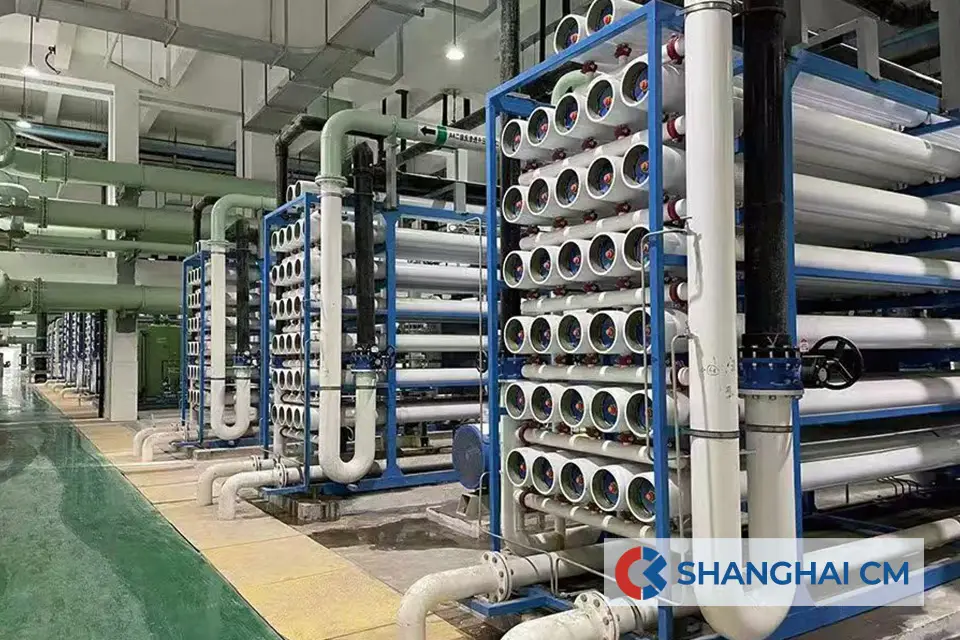
Main Types of RO Systems
Industrial RO systems can be classified according to feed water source, system configuration, and application requirements. Understanding these types is essential for correct RO system selection.
Types of RO Systems by Feed Water Source
Brackish Water RO System
A brackish water RO system is designed for groundwater or surface water with moderate salinity.
- Feed water TDS: 1,000–10,000 mg/L
- Operating pressure: 1.0–2.5 MPa
- Typical recovery rate: 60–75%
This type of industrial RO system is commonly used for boiler feed water, industrial process water, food & beverage, and pharmaceutical applications.
For brackish water RO projects, pretreatment design and recovery rate control are critical to system stability.
Seawater RO System
A seawater RO system is used for desalination of high-salinity seawater.
- Feed water TDS: 30,000–45,000 mg/L
- Operating pressure: 5.5–8.0 MPa
- Recovery rate: 35–45%
Seawater RO systems require high-pressure pumps and energy recovery devices (ERD) to reduce operating energy consumption and ensure long-term economic operation.
Wastewater / Reclaimed Water RO System
A RO system for wastewater reuse is typically applied after biological treatment such as MBR or tertiary treatment.
- Feed water: MBR effluent or treated industrial wastewater
- Key challenge: membrane fouling and scaling control
In practice, UF + RO or MBR + RO systems are recommended to achieve stable long-term operation in wastewater reuse projects.
Wastewater RO systems almost always require customized system design rather than standard RO packages.
Types of RO Systems by System Configuration
Single Pass RO System
A single pass RO system uses one membrane separation stage.
- Salt rejection: 95–99%
- Lower capital cost
- Suitable for general industrial water supply
Double Pass RO System
A double pass RO system consists of two RO stages in series to achieve higher product water quality.
- Ultra-low conductivity
- Higher system stability for critical processes
Double pass RO systems are widely used in power plants, electronics manufacturing, and pharmaceutical water systems.
Multi-Stage RO System
A multi-stage RO system is designed for large-capacity industrial or municipal applications.
- Optimized pressure distribution
- Improved energy efficiency
- Suitable for large RO plants
Key Components of an Industrial RO System
A complete industrial RO water treatment system typically includes:
- Pretreatment system (sand filter, activated carbon, softener, UF or MBR)
- High-pressure pump
- RO membrane elements
- Pressure vessels
- Chemical dosing system (antiscalant, dechlorination, pH control)
- CIP (Clean-In-Place) system
- PLC control system with HMI
- Online instruments (flow, pressure, conductivity)
In industrial RO plants, proper integration of these components is more important than any single component brand.
How Does an RO System Work?
The working process of an industrial RO system includes:
- Feed water pretreatment to remove suspended solids and fouling substances
- Pressurization by high-pressure pumps
- Separation through RO membranes into permeate and concentrate
- Collection of treated water for industrial use
- Automatic monitoring and system control
This process allows continuous and stable water production for industrial applications.
Key Design Parameters of RO Systems
Professional RO system design must consider the following parameters:
- Feed water TDS and SDI
- Recovery rate
- Operating pressure
- Salt rejection rate
- System capacity (m³/day or m³/h)
- Operating temperature
Improper design of recovery rate or pretreatment often leads to frequent membrane fouling and high operating cost.
For industrial projects, RO system design parameters should always be evaluated based on long-term operation, not short-term performance.
How to Choose the Right RO System for Your Application
Choosing the correct industrial RO system requires engineering evaluation rather than price comparison.
Based on Feed Water Quality
Different water sources require different pretreatment processes and membrane selection.
Based on Required Product Water Quality
Single pass or double pass RO systems are selected according to conductivity and purity requirements.
Based on Operating Stability and Cost
For complex applications such as wastewater reuse or high-recovery systems, a customized RO system is strongly recommended.
Typical Applications of Industrial RO Systems
Industrial RO systems are commonly used for:
- Boiler feed water preparation
- Industrial process water
- Wastewater reclamation and reuse
- Seawater desalination
- Food, beverage, and pharmaceutical industries
Each application requires specific RO system configuration and design optimization.
Why System Stability Matters in Industrial RO Projects
In industrial projects, system stability is more important than maximum recovery or lowest capital cost.
A stable industrial RO system ensures:
- Continuous operation with minimal downtime
- Effective fouling and scaling control
- Long RO membrane service life
- Consistent product water quality
From an engineering perspective, long-term stability directly determines the total cost of ownership of an RO system.
Frequently Asked Questions About RO Systems
What is an industrial RO system?
An industrial RO system is a reverse osmosis water treatment system designed for continuous industrial operation and large-scale water treatment.
What is the difference between RO and UF systems?
RO removes dissolved salts, while UF mainly removes suspended solids and microorganisms.
What is the typical recovery rate of an RO system?
Industrial RO systems typically operate at 60–75% recovery, depending on feed water quality.
How long does an RO membrane last?
With proper pretreatment and operation, RO membranes typically last 3–5 years.
Is an RO system suitable for wastewater reuse?
Yes. RO systems are widely used in wastewater reuse when combined with UF or MBR pretreatment.
How to choose the right RO system for an industrial project?
System selection should be based on feed water quality, required product water quality, and long-term operating stability.
Conclusion
An industrial RO system is a critical solution for industrial water treatment, wastewater reuse, and desalination projects. Proper RO system selection, professional engineering design, and long-term operational stability are essential for reliable performance and cost efficiency.
For industrial applications, working with an experienced industrial RO system manufacturer helps ensure that the system is correctly designed for your specific water quality and operating conditions.