
What Is a Seawater RO System?
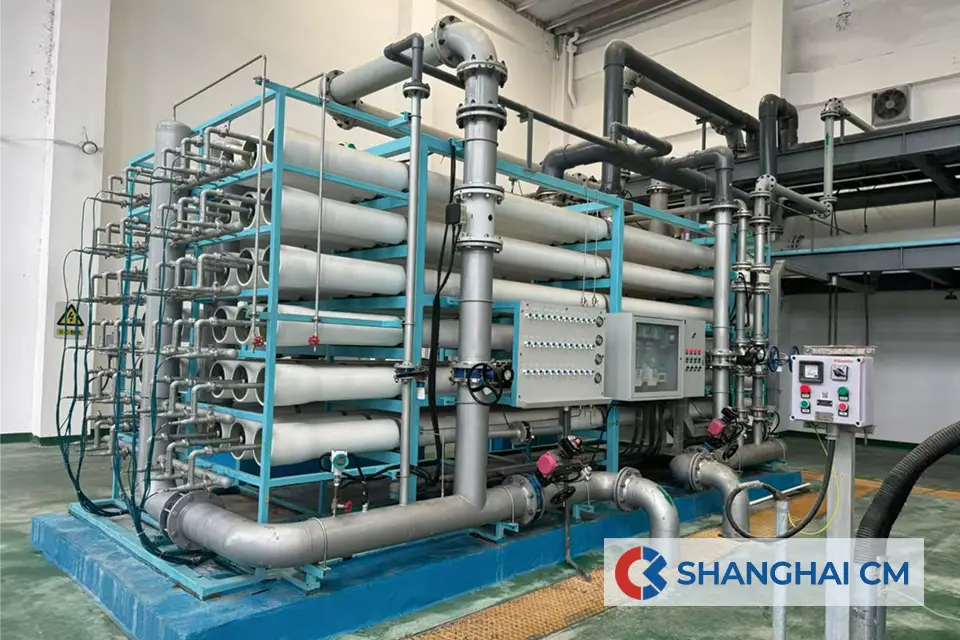
A seawater RO system (seawater reverse osmosis system, SWRO system) is a membrane-based desalination system designed to remove dissolved salts and impurities from seawater to produce fresh water suitable for industrial, municipal, or potable use.
Compared with brackish water RO systems, seawater RO systems operate under much higher pressure due to the high salinity of seawater. As a result, SWRO systems require specialized membranes, high-pressure pumps, and energy recovery devices to ensure stable and energy-efficient operation.
Seawater RO systems are widely used in coastal industrial plants, island water supply projects, municipal desalination plants, and offshore facilities.
In desalination projects, seawater RO system design focuses on long-term stability, energy efficiency, and membrane protection rather than maximum recovery alone.
Typical Feed Water Characteristics of Seawater RO Systems
Understanding seawater quality is the first step in proper SWRO system design.
Typical seawater parameters include:
- TDS: 30,000–45,000 mg/L
- High chloride concentration
- Presence of organic matter and microorganisms
- Seasonal variation in turbidity and temperature
These characteristics make pretreatment design one of the most critical parts of a seawater RO system.
Key Components of a Seawater RO System
A complete seawater RO desalination system typically includes:
- Seawater intake system (open intake or beach well)
- Pretreatment system (media filtration, UF, or dual media filters)
- High-pressure pump (SWRO duty)
- Seawater RO membranes
- High-pressure vessels
- Energy recovery device (ERD)
- Chemical dosing system (antiscalant, biocide, dechlorination)
- CIP system
- PLC control system and online instrumentation
In SWRO plants, system integration and component compatibility directly affect membrane lifespan and operating cost.
How Does a Seawater RO System Work?
The working process of a seawater RO system includes the following steps:
- Seawater is collected through an intake system and pretreated to remove suspended solids and biological contaminants
- High-pressure pumps raise the water pressure to overcome osmotic pressure
- Seawater passes through SWRO membranes, separating permeate from concentrated brine
- Fresh water (permeate) is collected, while brine is safely discharged
- System operation is continuously monitored and controlled
This process enables continuous freshwater production from seawater.
Key Design Parameters of Seawater RO Systems
Professional seawater [RO system design](Main Components of an Industrial RO Water Treatment System "RO system design") requires careful consideration of the following parameters:
- Feed water TDS and temperature
- Operating pressure (typically 5.5–8.0 MPa)
- Recovery rate (usually 35–45%)
- Salt rejection rate
- System capacity (m³/day)
- Energy consumption (kWh/m³)
Improper recovery rate or pretreatment design often leads to severe membrane fouling, high energy cost, and unstable operation.
For seawater desalination projects, conservative recovery rate design is often more economical in the long term.
Energy Recovery Devices in Seawater RO Systems
Energy recovery devices (ERD) are essential components of modern SWRO desalination plants.
Functions of ERD:
- Recover pressure energy from concentrate stream
- Reduce overall energy consumption
- Improve system efficiency and operating stability
Common ERD types include pressure exchangers and turbine-based devices.
Without ERD, large-scale seawater RO systems are rarely economically viable.
Typical Applications of Seawater RO Systems
Seawater RO systems are widely applied in:
- Municipal desalination plants
- Industrial water supply for coastal factories
- Island and remote area water supply
- Offshore oil & gas facilities
- Power plants near coastal areas
Each application requires specific system configuration and reliability considerations.
Common Challenges in Seawater RO Projects
Seawater RO systems face several operational challenges:
- Membrane fouling due to biofouling and organic matter
- Scaling caused by high salinity
- High operating pressure and energy consumption
- Corrosion risk in system materials
Addressing these challenges requires robust pretreatment design, proper material selection, and professional system engineering.
Why Long-Term Stability Matters in Seawater RO Systems
In seawater desalination projects, system stability is more important than maximum water recovery.
A stable seawater RO system ensures:
- Continuous operation with minimal downtime
- Extended membrane service life
- Predictable operating cost
- Reliable freshwater supply
From a project perspective, long-term operational stability determines the overall success of seawater desalination plants.
Seawater RO System FAQ (Engineering & Design)
1. What is a seawater RO (SWRO) system?
A seawater RO system is a desalination technology that uses high-pressure membranes to remove dissolved salts (TDS 30,000–45,000 mg/L) from seawater, producing potable or industrial-grade freshwater.
2. What pressure is required for seawater RO systems?
Typical operating pressure ranges from 55–80 bar (5.5–8.0 MPa), depending on feedwater salinity, temperature, and membrane type.
3. What is the recovery rate of SWRO systems?
Most seawater RO systems operate at a 35–45% recovery rate, balancing freshwater production with membrane fouling control and energy efficiency.
4. How long do seawater RO membranes last?
With proper pretreatment and maintenance, SWRO membranes typically last 3–5 years, though lifespan can vary based on fouling, scaling, and cleaning frequency.
5. What pretreatment is required before SWRO?
Common pretreatment processes include:
- Coagulation & flocculation
- Multimedia filtration or ultrafiltration (UF)
- Cartridge filtration (5 μm)
These steps are critical to prevent membrane fouling.
6. What is an energy recovery device (ERD)?
An ERD captures energy from the high-pressure brine stream and transfers it to incoming feedwater, reducing total energy consumption by up to 30–50%.
7. What is the energy consumption of seawater desalination?
Modern SWRO systems typically consume 3.0–4.5 kWh/m³, depending on system design, energy recovery efficiency, and feedwater conditions.
8. What are the main applications of SWRO systems?
- Municipal water supply
- Industrial process water
- Offshore platforms (oil & gas)
- Island and coastal desalination projects
9. What is the difference between SWRO and BWRO systems?
- SWRO: High salinity (seawater), high pressure
- BWRO: Lower salinity (brackish water), lower pressure
SWRO requires more robust membranes and energy recovery systems.
10. How to choose the right SWRO system capacity?
System capacity should be determined based on:
-
Daily water demand (m³/day)
-
Feedwater salinity
-
Required recovery rate
-
Future expansion needs
-
Conclusion
A seawater RO system is a proven and reliable solution for desalination projects in coastal and island regions. Successful implementation depends on proper system design, effective pretreatment, energy recovery integration, and long-term operational stability.
For desalination projects, working with an experienced seawater RO system manufacturer helps ensure that the system is optimized for local seawater conditions and long-term performance.
For seawater desalination projects, a detailed feed water analysis and professional SWRO system design evaluation are strongly recommended before final equipment selection. Proper system configuration significantly reduces operational risk and long-term cost.