
Industrial Ultrafiltration Membrane Guide Selection, Design, Applications & Maintenance
Industrial UF membranes are widely used for stable turbidity removal, suspended solids separation, bacteria reduction and reliable RO pretreatment.

Featured Product
UF Membrane Module / Industrial UF Skid
Primary Use
RO Pretreatment
Common Materials
PVDF / PES / PAN
Module Type
Hollow Fiber UF
Applications
Reuse, Surface Water, Seawater
A good ultrafiltration membrane solution should not only provide clean permeate. It should also maintain stable flux, resist fouling, allow effective backwashing and chemical cleaning, and match the operating conditions of the project. In many industrial projects, UF membrane performance directly affects the reliability of the downstream reverse osmosis system, nanofiltration system or reuse process.
This guide explains how industrial ultrafiltration membranes work, how to select the right membrane material and module type, what operating parameters should be considered, and how to maintain UF membranes for long-term stable operation.
What Is an Ultrafiltration Membrane?
An ultrafiltration membrane is a pressure-driven separation membrane used to remove suspended solids, colloids, turbidity, bacteria, macromolecular organic matter and some microorganisms from water. Compared with conventional sand filtration or multimedia filtration, UF membranes provide a more consistent separation barrier because the filtration is controlled by membrane pore structure rather than only by filter media depth.
In industrial water treatment, ultrafiltration membranes are commonly used before RO systems, after biological treatment systems, in surface water treatment plants, in wastewater reuse systems, and in process water polishing applications.
The typical separation range of ultrafiltration is between microfiltration and nanofiltration. UF membranes do not remove dissolved salts like RO membranes, but they are highly effective for removing particulate and colloidal impurities that cause fouling in downstream systems.
Main Contaminants Removed by UF Membranes
Because of these capabilities, UF membranes are frequently used as a stable pretreatment barrier before reverse osmosis systems. For industrial RO projects, you can also refer to our Industrial Reverse Osmosis Systems page to understand how UF and RO can be combined in complete water treatment systems.
How Does an Industrial UF Membrane Work?
Industrial ultrafiltration membranes separate contaminants through physical size exclusion. When feed water passes through the membrane surface under pressure, water molecules and small dissolved substances pass through the membrane pores, while larger suspended particles, colloids and microorganisms are retained.
The filtered water is called permeate or filtrate. The retained impurities are discharged through backwash, forward flush, air scouring or chemical cleaning depending on system design.
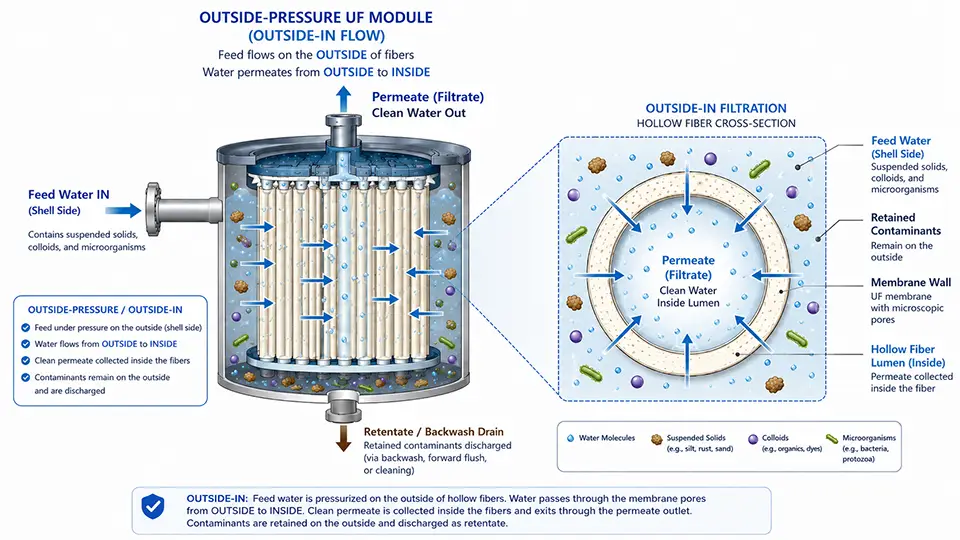
Most industrial UF membranes are designed in hollow fiber form. Thousands of hollow fibers are packed inside a module. Each fiber acts as a tiny filtration channel. Depending on the membrane design, water may flow from inside to outside or outside to inside.
Hollow Fiber UF Membrane Structure
Hollow fiber membranes are the most widely used UF membrane format in industrial water treatment. They provide a large membrane area in a compact module, which makes them suitable for medium and large-scale projects.
A typical hollow fiber UF membrane module includes:
The hollow fiber design allows high packing density and efficient filtration. However, correct system design is essential. If the feed water contains excessive suspended solids, oil, grease, oxidants or abrasive particles, pretreatment and operating control must be carefully designed to protect the membrane fibers.
Inside-Out vs Outside-In UF Membranes
Industrial UF membranes can be designed as inside-out or outside-in filtration modules. The correct choice depends on feed water quality, fouling tendency, cleaning method and project requirements.
I Inside-Out UF Membranes
Feed water enters the inner bore of the hollow fiber and passes outward through the membrane wall. Impurities are retained inside the fiber channel and removed by flushing and cleaning.
Advantages
- Clear flow path
- Stable filtration control
- Suitable for many industrial process water applications
- Easy hydraulic design in pressurized systems
Limitations
- Fiber channels may be blocked by high suspended solids
- Requires proper pretreatment for high-turbidity water
- Not always ideal for heavy wastewater applications
O Outside-In UF Membranes
Feed water surrounds the outside of the hollow fibers and permeate flows inward through the membrane wall. Solids are retained outside the fiber surface and removed by backwash, air scouring or flushing.
Advantages
- Better tolerance to suspended solids
- Suitable for air scouring cleaning
- Commonly used in municipal and industrial water reuse
- Good option for RO pretreatment with variable feed water
Limitations
- Requires good module and system design
- Air scouring and cleaning conditions must be controlled
- Incorrect operation may increase fiber stress
There is no single best structure for every project. The right choice depends on feed water quality, operating pressure, cleaning strategy, required filtrate quality and system capacity.
Common UF Membrane Materials
The membrane material determines chemical resistance, mechanical strength, fouling behavior, operating tolerance and long-term stability. In industrial applications, the most common UF membrane materials include PVDF, PES and PAN.
PVDF UF Membranes
PVDF (polyvinylidene fluoride) is one of the most widely used materials for industrial ultrafiltration membranes. It has strong chemical resistance, good mechanical strength and excellent oxidation resistance.
Advantages
- Strong mechanical strength
- Good chemical resistance
- Suitable for frequent backwash and chemical cleaning
- Good oxidation resistance
- Suitable for challenging feed water conditions
Typical Applications
- RO pretreatment
- Wastewater reuse
- Seawater desalination pretreatment
- River and lake water treatment
- Industrial process water filtration
PES UF Membranes
PES (polyethersulfone) membranes usually have good hydrophilicity and can provide stable filtration performance in many clean water and process water applications.
Advantages
- Good hydrophilic performance
- Stable filtration flux
- Good separation performance
Typical Applications
- Process water polishing
- Food and beverage water treatment
- Clean water UF systems
PAN UF Membranes
PAN (polyacrylonitrile) can offer good hydrophilicity and fouling resistance in specific water treatment conditions, particularly for some industrial wastewater applications.
Advantages
- Good hydrophilic properties
- Suitable for oily wastewater pretreatment
- Stable separation in selected applications
Typical Applications
- Industrial wastewater treatment
- Special separation applications
PVDF vs PES vs PAN: How to Choose?
| Material | Main Strength | Suitable Applications | Selection Notes |
|---|---|---|---|
| PVDF | Strong chemical resistance & mechanical strength | RO pretreatment, wastewater reuse, surface water, seawater | Good choice for demanding industrial projects |
| PES | Good hydrophilicity and stable flux | Process water, clean water, food and beverage | Chemical cleaning limits should be checked |
| PAN | Good hydrophilicity in selected applications | Industrial wastewater and special separation | Select based on water characteristics |
For most industrial water treatment and RO pretreatment projects, PVDF hollow fiber UF membranes are widely used because of their balance of durability, chemical resistance and cleaning recovery.
Pressurized UF Membrane vs Immersed UF Membrane
Industrial ultrafiltration systems can be divided into pressurized UF systems and immersed UF systems.
Pressurized UF Systems
Uses enclosed UF membrane modules installed in a skid or rack. Feed water is pumped into the module under pressure.
Common Applications
- RO pretreatment
- Surface water treatment
- Seawater desalination pretreatment
- Containerized water treatment systems
Advantages
- Compact footprint
- Easy modular expansion
- Easy to combine with RO, NF or EDI systems
Immersed UF Systems
Places membrane modules directly inside a tank or membrane basin. Suction or low-pressure filtration draws water through the membrane.
Common Applications
- Municipal wastewater reuse
- MBR-related treatment
- High suspended solids applications
Advantages
- Suitable for large flow projects
- Can be integrated with biological treatment
- Lower operating pressure in many cases
For many industrial RO pretreatment and compact system applications, pressurized UF modules are often easier to integrate. For large wastewater reuse or membrane bioreactor applications, immersed membrane systems may be more suitable.
Key UF Membrane Operating Parameters
Correct operating parameters are essential for stable UF system performance. Even a high-quality membrane can fail early if the system is operated with excessive flux, poor backwash control, incorrect chemical dosing or unsuitable feed water.
Flux
Flux refers to the amount of permeate produced per unit membrane area per hour (LMH). Higher flux can reduce membrane area and system cost, but also increases fouling risk. In industrial projects, stable long-term operation is more important than maximum initial output. Flux selection should consider feed water turbidity, suspended solids, organic content, temperature, fouling tendency and seasonal water quality changes.
Transmembrane Pressure (TMP)
TMP is the pressure difference across the membrane and one of the most important indicators of UF membrane fouling. If TMP gradually increases under the same flow condition, it usually means the membrane resistance is increasing due to fouling, scaling, biological growth or blocked pores. Monitoring TMP trends is more useful than looking at one single pressure value.
Backwash Frequency
Backwash is a routine cleaning process used to remove particles from the membrane surface or fiber channels. During backwash, filtrate or clean water is pushed in reverse direction through the membrane. Incorrect backwash design may lead to faster TMP increase, shorter membrane life and higher chemical cleaning frequency.
Air Scouring
Air bubbles create turbulence around the membrane fibers and help remove accumulated solids. Air scouring is especially useful for outside-in UF membranes, immersed membrane systems and wastewater reuse applications. However, excessive air flow or incorrect air distribution may damage fibers or increase energy consumption.
Chemically Enhanced Backwash (CEB)
CEB uses low-concentration chemicals during backwash to improve fouling removal. It is commonly used to control organic fouling, biological fouling and inorganic deposits. Common CEB chemicals may include sodium hypochlorite, sodium hydroxide, hydrochloric acid and citric acid depending on membrane material.
Clean-in-Place (CIP)
CIP is a deeper chemical cleaning process used when routine backwash and CEB can no longer recover membrane performance. CIP is usually required when TMP remains high after backwash, permeate flow cannot be restored, normalized permeability decreases significantly, or organic/inorganic fouling becomes severe.
Main Applications of Industrial Ultrafiltration Membranes
UF Membrane for RO Pretreatment
One of the most important applications of ultrafiltration is pretreatment before reverse osmosis systems. RO membranes are sensitive to suspended solids, colloids, microorganisms and organic fouling. UF can provide a stable barrier before RO by reducing turbidity and suspended particles.
For complete RO system solutions, visit our Industrial RO System page.
UF for Surface Water Treatment
Surface water from rivers, lakes and reservoirs often contains suspended solids, algae, organic matter, microorganisms and seasonal turbidity fluctuations. Common surface water UF applications include river water treatment, lake water treatment, reservoir water filtration, municipal water supply pretreatment, industrial process water production and RO pretreatment for surface water.
UF for Seawater Desalination Pretreatment
Seawater desalination systems require stable pretreatment before SWRO membranes. UF pretreatment is widely used in containerized desalination systems, island water supply, coastal industrial plants and municipal desalination projects. For seawater desalination solutions, view our Seawater Desalination System page.
UF for Industrial Wastewater Reuse
Industrial wastewater reuse projects often require stable removal of suspended solids and colloids before RO, NF or other advanced treatment processes. Common wastewater reuse applications include:
UF for Boiler Feed Water Pretreatment
Boiler feed water systems require stable pretreatment to reduce suspended solids and protect downstream softening, RO or demineralization systems.
Typical Process Flow
How to Select the Right Industrial UF Membrane
Selecting the right UF membrane requires more than comparing price or membrane area. The correct selection should be based on feed water quality, application, system capacity, cleaning strategy and long-term operation cost.
Confirm Feed Water Source
Surface water, groundwater, seawater, municipal wastewater, industrial wastewater, cooling tower blowdown, process water or RO concentrate.
Check Feed Water Quality
Check turbidity, SS, COD/TOC, oil and grease, iron, manganese, hardness, silica, temperature, pH, chlorine, microbiological activity and seasonal changes.
Define the Purpose of UF
Producing clear filtered water, protecting RO membranes, reducing SDI, treating surface water, polishing biological effluent, pretreating seawater or reusing industrial wastewater.
Select the Membrane Material
PVDF for heavy-duty industrial projects. PES for cleaner process water. PAN for special wastewater applications depending on water quality.
Select Module Type
Consider pressurized vs immersed UF, inside-out vs outside-in, whether air scouring is required, and whether the project is new or a replacement.
Determine Design Flux
A conservative flux often provides better long-term performance, especially for difficult water. If design flux is too high, the system may experience frequent cleaning and short membrane life.
Design the Cleaning Strategy
A good UF system should include forward flush, backwash, air scouring, CEB, CIP, drain and rinse, chemical dosing control and online monitoring.
Check Chemical Compatibility
UF membranes may be exposed to oxidants, acids, alkalis and cleaning chemicals. Incorrect chemical use may cause membrane pore damage, fiber brittleness and shortened membrane life.
Common UF Membrane Problems
Even well-designed UF systems may face operational problems if feed water quality changes or maintenance is insufficient.
High TMP
Usually indicates membrane fouling, blocked fiber channels, scaling or insufficient cleaning. Monitor TMP trends regularly.
Low Permeate Flow
May be caused by fouling, incorrect valve operation, pump issues, low feed pressure, blocked strainers or membrane damage.
High Filtrate Turbidity
Possible causes include fiber breakage, sealing failure, damaged membrane modules or incorrect system operation.
Frequent Chemical Cleaning
If CEB or CIP frequency becomes too high, the system may be operating under excessive flux, poor pretreatment or unsuitable cleaning conditions.
Fiber Breakage
Fiber breakage may occur due to excessive pressure shock, air scouring problems, poor handling, chemical damage or aging. Integrity testing can help detect early fiber breakage.
UF Membrane Cleaning and Maintenance
Proper cleaning is essential for long-term UF membrane performance. A complete maintenance program should include routine monitoring, backwash, chemically enhanced backwash and periodic CIP.
Daily Monitoring
Record feed pressure, permeate pressure, TMP, permeate flow, filtrate turbidity, backwash pressure, chemical dosing, water temperature, pH and cleaning frequency. Normalized data is more useful than raw data.
Backwash
Removes reversible fouling from the membrane surface or fiber channels. Filtrate or clean water is pushed in reverse direction through the membrane. Perform regularly according to system design.
CEB (Chemically Enhanced Backwash)
Helps control organic fouling, biological fouling and inorganic deposits. Chemical type and dosage should match the membrane material and fouling type.
CIP (Clean-in-Place)
Used for deeper cleaning when normal backwash and CEB cannot recover performance. Acid cleaning for inorganic scaling; alkaline or oxidant cleaning for organic and biological fouling.
Integrity Testing
For applications requiring high filtrate quality, integrity testing can help detect fiber breakage or module leakage.
When Should UF Membranes Be Replaced?
UF membranes should be replaced when cleaning can no longer restore performance or when the membrane cannot maintain required filtrate quality.
Signs That Replacement May Be Needed
For replacement projects, customers can send the existing UF membrane model, photos, dimensions and operating data for evaluation.
Industrial UF Membrane Customization
Some projects require customized UF membranes because standard modules may not match the old system or project conditions.
If you need custom UF membrane modules, visit our Ultrafiltration Membranes page or contact our engineering team.
How to Choose a UF Membrane Manufacturer
Choosing a UF membrane manufacturer is not only about unit price. For industrial and engineering projects, the supplier should be able to support technical selection, replacement evaluation, project customization and long-term service.
About CM
Why Work with CM for Industrial UF Membranes?
CM provides industrial water treatment membranes and systems for global B2B projects. Our UF membrane solutions can be used in RO pretreatment, wastewater reuse, surface water treatment, seawater desalination pretreatment and process water applications. We support engineering companies, system integrators and industrial users with membrane selection, project matching, replacement evaluation and customized production.
Related Resources
| Resource | Link |
|---|---|
| Industrial ultrafiltration membranes | /products/ultrafiltration-membranes/ |
| Industrial reverse osmosis systems | /products/industrial-reverse-osmosis-systems/ |
| Seawater desalination system | /products/...seawater-desalination-system/ |
| MBR membranes for wastewater treatment | /products/mbr-membranes/ |
| Custom UF membrane modules | /custom-ultrafiltration-membrane-ups90-10-pvdf/ |
| Contact our engineering team | /contact/ |
FAQ About Industrial Ultrafiltration Membranes
What is an industrial ultrafiltration membrane?
An industrial ultrafiltration membrane is a pressure-driven membrane used to remove suspended solids, turbidity, colloids, bacteria and macromolecular contaminants from water. It is widely used in RO pretreatment, surface water treatment, wastewater reuse, seawater desalination pretreatment and industrial process water systems.
Can UF membranes remove dissolved salts?
No. UF membranes do not remove dissolved salts like reverse osmosis membranes. UF mainly removes particles, colloids, turbidity and microorganisms. If salt removal is required, UF is usually used as pretreatment before RO or NF systems.
Why is UF used before RO systems?
UF is used before RO to reduce suspended solids, turbidity and colloidal particles. This helps protect RO membranes from fouling, improves SDI stability and reduces the frequency of RO membrane cleaning.
Which UF membrane material is better, PVDF or PES?
PVDF is often preferred for demanding industrial applications because it has strong chemical resistance and mechanical strength. PES has good hydrophilicity and is suitable for many clean water and process water applications. The best choice depends on feed water quality, cleaning chemicals and operating conditions.
What causes high TMP in UF membrane systems?
High TMP is usually caused by membrane fouling, blocked fibers, organic matter, scaling, biological growth, iron or manganese fouling, oil contamination or insufficient cleaning. Operators should check feed water quality, backwash performance, chemical cleaning condition and normalized permeability trends.
How often should UF membranes be cleaned?
Routine backwash is normally performed frequently during operation, while chemically enhanced backwash and CIP are performed according to fouling condition and system design. Cleaning frequency depends on feed water quality, design flux, operating pressure and membrane material.
When should UF membranes be replaced?
UF membranes should be replaced when cleaning can no longer restore flow or TMP, filtrate turbidity becomes unstable, fiber breakage occurs, or the system cannot meet production requirements. Replacement decisions should be based on operating data, cleaning recovery and filtrate quality.
Can UF membranes be customized for replacement projects?
Yes. UF membrane modules can often be customized according to membrane material, module size, connection type, membrane area, filtration direction and system requirements. This is useful when replacing old UF modules in existing systems.
Is UF suitable for wastewater reuse?
Yes. UF is widely used in wastewater reuse projects as a polishing or pretreatment process before RO, NF or disinfection. However, industrial wastewater may contain oil, organics, chemicals or scaling substances, so pretreatment and membrane selection must be carefully designed.
What information is needed to select a UF membrane?
To select a UF membrane, it is helpful to provide feed water source, water analysis, flow rate, operating hours, target application, required filtrate quality, existing system information and cleaning requirements. For replacement projects, the old module model and photos are also useful.
Need Help Selecting an Industrial UF Membrane?
Choosing the right ultrafiltration membrane depends on feed water quality, system capacity, membrane material, filtration direction, cleaning method and long-term operating requirements.
If you are designing a new UF system, upgrading RO pretreatment, planning a wastewater reuse project or replacing existing UF membrane modules, CM can help evaluate your project and recommend a suitable membrane solution.
Send us your feed water analysis, flow rate, application and existing membrane model. Our engineering team will help you select a suitable UF membrane module for your project.