
An industrial RO system is not just a set of membranes—it is a fully engineered water treatment system. Understanding its main components is essential for system design, operation, and long-term stability.
This guide explains each component of an [industrial RO water treatment system](Key Design Parameters of Industrial RO Systems Why RO System Design Parameters Matter "industrial RO water treatment system"), their function, and key considerations for engineers and project managers.
For industrial RO projects, a clear understanding of system components ensures reliable operation and helps optimize performance.
1. Pretreatment System
What It Is
The pretreatment system prepares feed water before it enters the RO membranes. It removes suspended solids, chlorine, organics, and scale-forming ions to protect the membranes from fouling and damage.
Typical Components
- Sand filter: Removes large particles and sediments.
- Activated carbon filter: Removes chlorine and organic matter.
- Water softener: Reduces hardness to prevent scaling.
- Ultrafiltration (UF) / Microfiltration (MF): Optional high-performance filtration for fouling-sensitive applications.
Proper pretreatment is critical: inadequate pretreatment is the most common reason for RO membrane failure.
2. High-Pressure Pump
Function
The high-pressure pump delivers water to the RO membranes at the required operating pressure to overcome osmotic pressure.
Key Considerations
- Pump capacity should match system recovery rate and flow.
- Pump materials must resist corrosion if feed water contains salts or chemicals.
- Efficiency is critical for energy cost control in large industrial RO systems.
3. RO Membrane Elements
Function
RO membranes are the core component that separates salts, organics, and impurities from water.
Types
- Brackish water RO membranes: Lower operating pressure, high salt rejection.
- Seawater RO membranes: High-pressure operation, designed for high TDS feed water.
- Fouling-resistant membranes: For wastewater reuse or high-turbidity feed water.
Key Parameters
- Salt rejection (%)
- Water flux (GFD / LMH)
- Maximum operating pressure
Membrane selection depends on feed water quality, recovery rate, and application requirements.
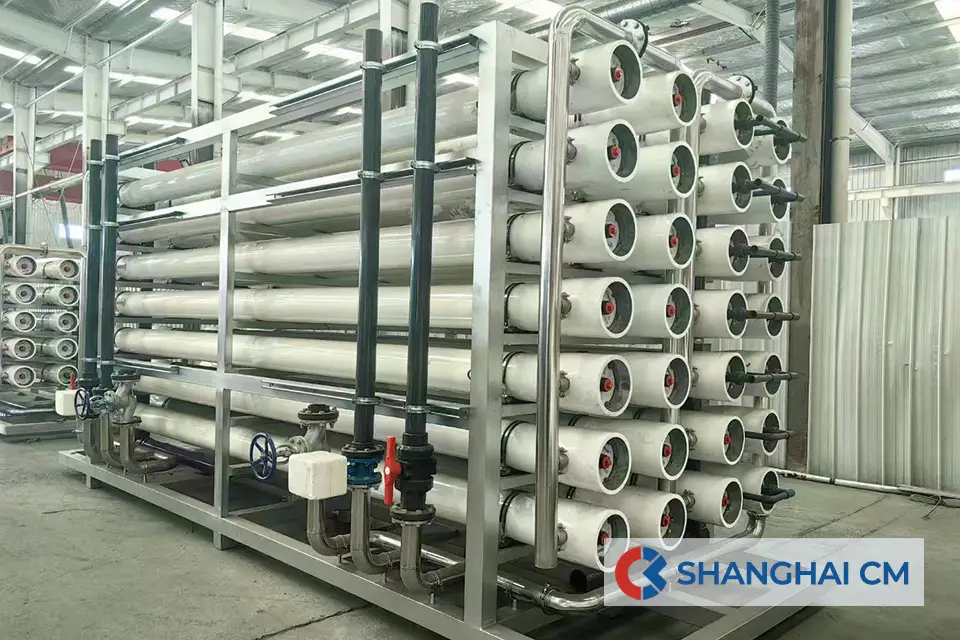
4. Pressure Vessels
Function
Pressure vessels house the RO membrane elements and provide structural support for high-pressure operation.
Key Considerations
- Must withstand operating pressure and temperature.
- Material selection (FRP or stainless steel) depends on water chemistry.
- Proper design ensures uniform flow distribution across membranes.
5. Chemical Dosing System
Function
The chemical dosing system protects membranes and improves system performance by preventing scaling, fouling, and corrosion.
Typical Chemicals
- Antiscalants: Prevent scale formation from hardness ions.
- Dechlorination agents (sodium bisulfite): Protect chlorine-sensitive membranes.
- pH adjusters: Ensure optimal membrane performance.
Correct dosing reduces cleaning frequency and extends membrane life.
6. CIP (Clean-In-Place) System
Function
The CIP system allows automated or semi-automated cleaning of RO membranes without dismantling the system.
Key Considerations
- Cleaning frequency depends on feed water fouling potential.
- Uses acid, alkali, or detergent solutions to remove scale and biofilm.
- Proper CIP design minimizes downtime and ensures consistent water quality.
7. Control System (PLC / HMI)
Function
The control system monitors and manages system operation parameters:
- Flow rate
- Pressure
- Conductivity
- Recovery rate
Benefits
- Automatic alarms for abnormal conditions
- Optimized operation for energy efficiency and membrane protection
- Remote monitoring capability for large industrial plants
8. Online Instruments
Function
Instruments provide real-time data to ensure system performance and product water quality.
Common Instruments
- Conductivity meters (permeate and concentrate)
- Flow meters (permeate, concentrate, feed water)
- Pressure gauges (before and after membrane)
- SDI measurement devices
Proper instrumentation allows operators to detect fouling, scaling, or leaks early.
Conclusion
Understanding the main components of an industrial RO water treatment system is essential for:
- Selecting the right system
- Designing reliable operation
- Reducing downtime and operating costs
- Ensuring long-term membrane performance
For industrial RO projects, working with a professional RO system manufacturer ensures the system components are optimized for your specific water quality and project requirements.