
Why RO Systems Are Used in Wastewater Reuse Projects
With increasing water scarcity and stricter discharge regulations, wastewater reuse has become a critical solution for industrial and municipal water management.
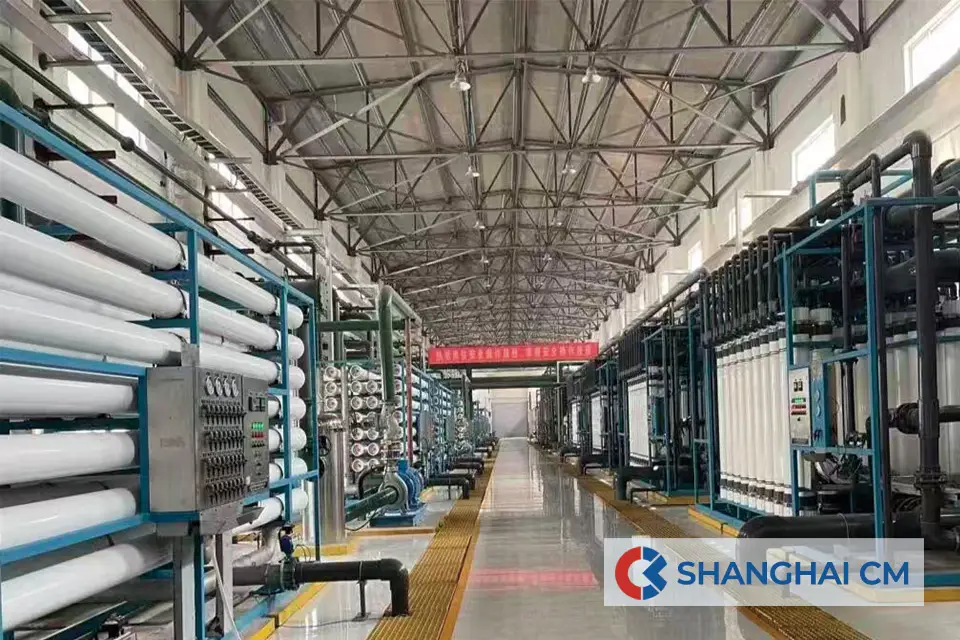
An RO system for wastewater reuse is widely applied to remove dissolved salts, organic compounds, nutrients, and trace contaminants from treated wastewater, producing high-quality reclaimed water suitable for industrial reuse or further purification.
Compared with conventional tertiary treatment, industrial RO systems provide reliable and consistent water quality, making them essential in high-standard reuse projects.
Typical Wastewater Sources for RO Systems
RO systems for wastewater reuse are commonly applied to:
- Municipal wastewater after secondary or tertiary treatment
- Industrial wastewater (chemical, textile, electronics, food & beverage)
- Oil & gas produced water
- Landfill leachate (after advanced pretreatment)
These wastewater sources typically contain high organic load, variable water quality, and fouling-prone substances, which require careful system design.
Why MBR + RO Is the Preferred Configuration for Wastewater Reuse
In most wastewater reuse projects, a standalone RO system is not sufficient. The MBR + RO system has become the preferred configuration due to its superior pretreatment performance.
Advantages of MBR as RO Pretreatment
An MBR (Membrane Bioreactor) provides:
- Stable effluent quality
- Low turbidity and SDI
- Effective removal of suspended solids and microorganisms
- Reduced load on RO membranes
As a result, MBR significantly improves RO system stability and membrane lifespan.
In wastewater reuse projects, RO performance depends heavily on pretreatment quality. MBR is one of the most reliable pretreatment technologies for RO systems.
Typical MBR + RO System Configuration
A standard MBR + RO wastewater reuse system includes:
- Preliminary treatment (screening, grit removal)
- MBR system for biological treatment and solid-liquid separation
- Equalization and intermediate storage
- RO system for desalination and advanced purification
- Post-treatment or polishing (if required)
- Reclaimed water storage and distribution
This configuration allows the RO system to operate under stable feed water conditions, even when influent wastewater quality fluctuates.
Key Challenges in Wastewater RO Systems
Despite their effectiveness, wastewater RO systems face several challenges:
- Membrane fouling caused by organic matter
- Scaling due to high recovery rates
- Biofouling risks
- Variable feed water quality
Without proper pretreatment and design, these issues can result in frequent CIP cleaning, reduced recovery, and shortened membrane life.
Design Considerations for Stable Wastewater RO Operation
Professional wastewater RO system design should focus on long-term stability rather than maximum recovery.
Key design considerations include:
- Proper MBR effluent quality control (SDI, turbidity)
- Conservative recovery rate selection
- Adequate antiscalant dosing
- CIP system design and cleaning strategy
- Online monitoring of pressure, flow, and conductivity
In wastewater reuse projects, a stable RO system is more valuable than a high-recovery but unstable system.
Typical Applications of Reclaimed Water RO Systems
RO systems for wastewater reuse are widely used for:
- Cooling water make-up
- Boiler feed water preparation
- Industrial process water
- Zero Liquid Discharge (ZLD) pretreatment
- High-grade municipal water reuse
Each application requires customized RO system configuration and operating parameters.
Why System Stability Is Critical in Wastewater Reuse Projects
In wastewater reuse applications, system stability directly determines project success.
A well-designed MBR + RO system ensures:
- Continuous operation with minimal downtime
- Reduced membrane fouling and cleaning frequency
- Longer RO membrane service life
- Predictable operating cost
For EPC contractors and plant operators, stable operation is often more important than achieving the highest theoretical recovery rate.
Relationship Between This Page and Industrial RO System Design
This article focuses specifically on RO systems for wastewater reuse, as part of a broader industrial RO system design strategy.
For a comprehensive overview of RO system types, components, and selection principles, refer to the Industrial RO System – Types, Design, Applications & Selection Guide.
Frequently Asked Questions About Wastewater RO Systems
Is RO necessary for wastewater reuse projects?
RO is necessary when high-quality reclaimed water is required, especially for industrial reuse or ZLD applications.
Why is MBR recommended before RO?
MBR provides stable, low-SDI effluent that significantly reduces RO membrane fouling.
What recovery rate is typical for wastewater RO systems?
Recovery rates are usually designed conservatively, typically 60–70%, depending on water quality and scaling risk.
How often does a wastewater RO system require CIP cleaning?
Cleaning frequency depends on pretreatment quality and operating conditions, but proper design minimizes cleaning requirements.
Can wastewater RO systems operate continuously?
Yes. With proper pretreatment and system design, wastewater RO systems are suitable for continuous industrial operation.
Conclusion
An RO system for wastewater reuse is a critical component in modern water management strategies. The MBR + RO configuration has proven to be one of the most reliable solutions for producing high-quality reclaimed water from municipal and industrial wastewater.
Successful wastewater reuse projects depend on proper system selection, professional design, and long-term operational stability, rather than standard equipment alone.
For wastewater reuse or MBR + RO projects, providing detailed wastewater analysis and reuse requirements allows the RO system to be designed for stable long-term operation. Early-stage technical evaluation helps reduce operational risk and lifecycle cost.