
Boiler feed water treatment RO system regulate water hardness, total dissolved solids (TDS), silica and conductivity parameters. Such RO systems effectively protect boiler vessels and cut losses caused by scaling, corrosion, blowdown waste and unexpected equipment downtime.
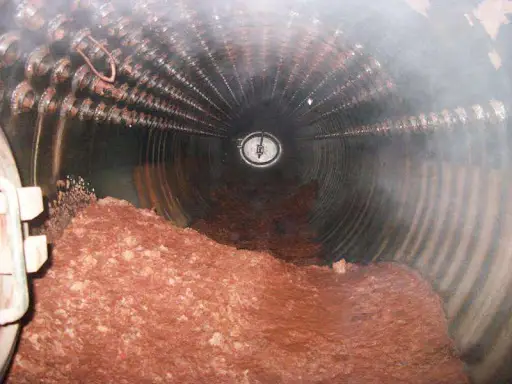
Why Boiler Feed Water Quality Matters
When you choose a water treatment system for a boiler room, you are not only buying equipment. You are protecting your steam system, production line, heat exchange equipment, and long-term operating cost.
Boiler feed water quality matters because even small amounts of hardness, dissolved salts, silica, iron, or suspended solids can cause serious problems after the water enters the boiler. As water turns into steam, impurities stay behind and become more concentrated inside the boiler. If these impurities are not controlled, you may face scaling, corrosion, high blowdown, poor steam quality, and frequent maintenance.
For many factories, the boiler is a critical part of daily production. If your boiler feed water is unstable, your whole production process may become unstable. That is why a properly designed boiler feed water purification system is important for food factories, textile plants, chemical plants, power plants, pharmaceutical facilities, paper mills, and other industrial users.
A reverse osmosis system for boiler feed water is commonly used to reduce dissolved salts before the water enters the boiler or before final polishing equipment such as EDI or mixed bed systems. The goal is simple: you need cleaner, more stable make-up water so your boiler can operate with fewer water-related problems.
Common Problems Caused by Poor Boiler Feed Water
Before you choose an industrial RO system for boiler feed water, you should first understand what problems the system needs to solve.
Scaling in Boiler Tubes
If your boiler make-up water contains hardness, calcium, magnesium, silica, or other scale-forming substances, these impurities can form deposits inside boiler tubes and heat transfer surfaces. Even a thin layer of scale can reduce heat transfer efficiency. As a result, your boiler may need more fuel to produce the same amount of steam.
Scaling can also create hot spots in boiler tubes. Over time, this may increase the risk of tube damage, unplanned shutdowns, and costly maintenance.
Corrosion Risk
Poor water quality can also increase corrosion risk. Chloride, dissolved oxygen, carbon dioxide, low pH, and unstable water chemistry can damage boiler tubes, pipelines, valves, and heat exchange equipment.
For you, corrosion is not only a technical issue. It can mean more repairs, shorter equipment life, water leakage, safety concerns, and unexpected downtime.
High Blowdown and Energy Loss
Boiler blowdown is necessary to control dissolved solids inside the boiler. However, if your feed water has high TDS, conductivity, or dissolved salts, you may need more frequent blowdown.
More blowdown means you lose more hot water, more heat energy, and more treated water. This increases your operating cost. A boiler feed water treatment RO system can help reduce dissolved solids before the water enters the boiler, which may help lower blowdown demand and improve overall boiler operation efficiency.
Unstable Steam Quality
If boiler water quality is not controlled, steam quality may also be affected. High silica, dissolved solids, or carryover can create problems in downstream steam users, turbines, heat exchangers, sterilization systems, or production processes.
If your factory depends on stable steam quality, you need to control boiler feed water from the beginning.
What Can an RO System Do for Boiler Feed Water Treatment?
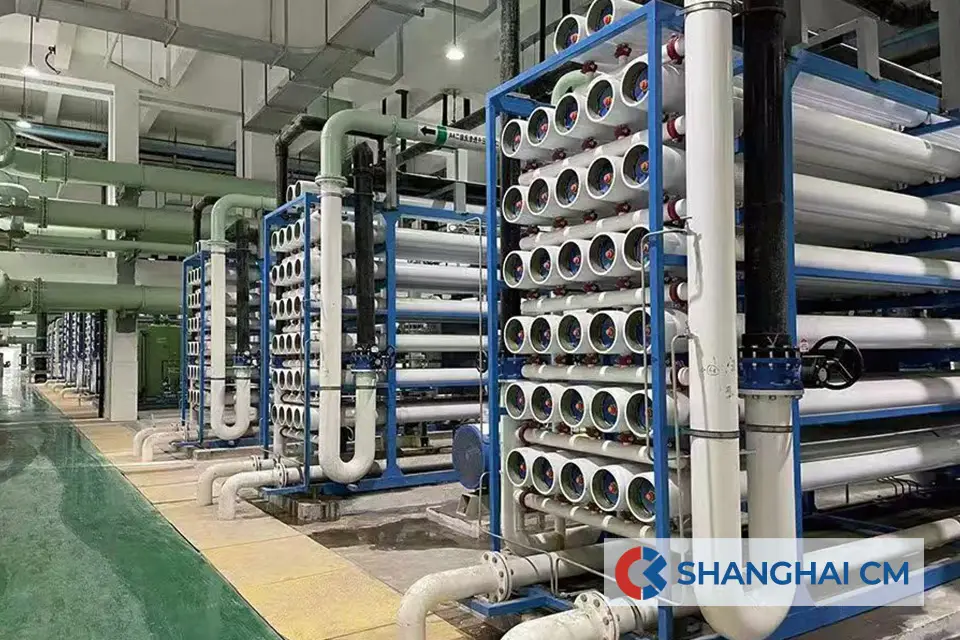
A reverse osmosis system for boiler feed water is designed to reduce dissolved salts and impurities from raw water or pretreated water. In boiler make-up water treatment, RO is usually used as the main desalination stage.
A well-designed RO water treatment system for steam boilers can help reduce:
- TDS
- Conductivity
- Hardness
- Dissolved salts
- Chloride
- Sulfate
- Silica
- Iron and manganese after proper pretreatment
- Organic matter after suitable pretreatment
- Particles and colloids when combined with good pretreatment
The main value of RO is not only lower numbers on a water quality report. The real value is more stable boiler operation. When your make-up water has lower dissolved solids and lower hardness, you can reduce the risk of scaling, reduce chemical pressure, improve feed water consistency, and support better boiler performance.
However, you should not treat RO as a single machine that can solve every problem alone. For boiler feed water treatment, RO is usually part of a complete system. Depending on your raw water source and boiler requirements, your system may include multimedia filtration, activated carbon filtration, water softening, antiscalant dosing, cartridge filtration, RO, EDI, mixed bed polishing, deaeration, and chemical dosing.
Can the RO System Meet Your Required Boiler Feed Water Quality?
This is usually your first question when you compare suppliers.
You need to know whether the RO system can produce water that matches your boiler feed water requirements. Different boilers require different water quality. A low-pressure boiler may have different requirements from a medium-pressure or high-pressure boiler. A small factory boiler may not need the same polishing process as a power plant boiler.
When evaluating a boiler feed water treatment RO system, you should pay attention to these water quality indicators:
- Conductivity
- TDS
- Total hardness
- Silica
- Chloride
- Iron
- Manganese
- Suspended solids
- SDI
- pH
- Alkalinity
- Organic matter
If you only ask for a standard RO machine without checking your actual target water quality, the final system may not match your boiler. For example, single-pass RO may be enough for some low-pressure boiler applications, but it may not be enough for higher purity requirements. In other cases, you may need double-pass RO, RO + EDI, or RO + mixed bed polishing.
That is why you should provide your raw water analysis report, boiler type, pressure level, make-up water demand, and required outlet water quality before asking for a quotation.
Is Single-Pass RO Enough, or Do You Need Double-Pass RO?
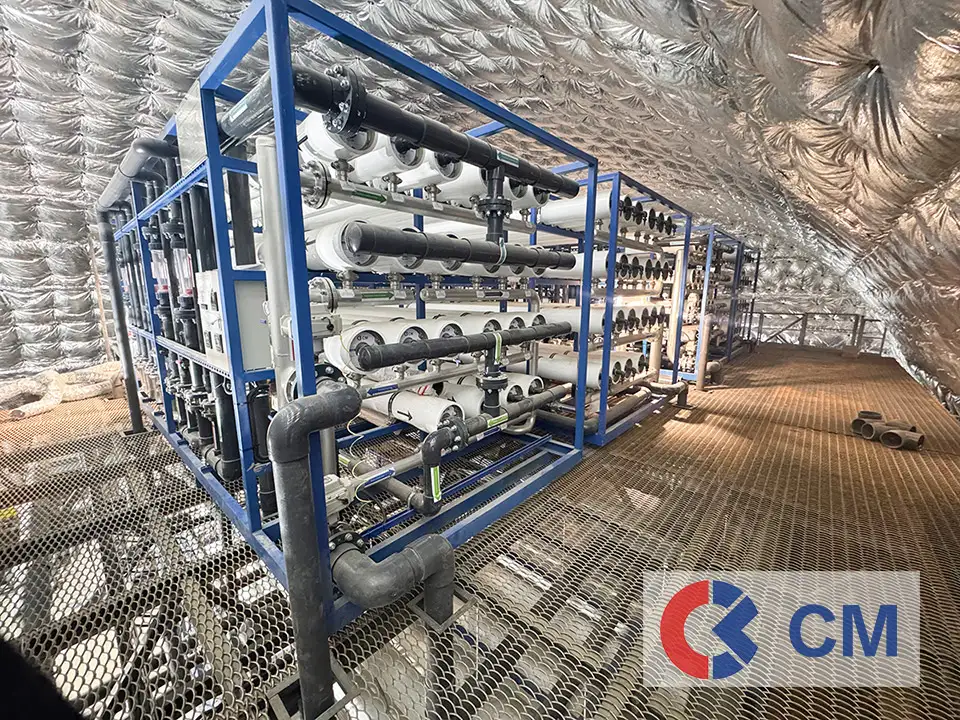
Many buyers ask whether one-stage RO is enough for boiler feed water. The answer depends on your boiler pressure, raw water quality, and required permeate quality.
A single-pass RO system can remove a large portion of dissolved salts and hardness. It may be suitable for many low-pressure boiler make-up water treatment projects, especially when the raw water quality is not too difficult and the required outlet conductivity is moderate.
A double-pass RO system provides further desalination. In this design, the permeate from the first RO stage becomes the feed water for the second RO stage. This can help you achieve lower conductivity and better water quality stability.
For more demanding boiler feed water applications, you may need:
- Single-pass RO for basic desalination
- Double-pass RO for lower conductivity
- RO + EDI for continuous high-purity water production
- RO + mixed bed for final polishing
- RO + degassing system when carbon dioxide control is needed
- RO + chemical conditioning before boiler feed
The key point is this: you should not select the RO system only by equipment price. You should select it by final water quality, system stability, and long-term boiler protection.
Applicable Standards
- Industrial boilers (operating pressure <3.8 MPa):
- Utility & thermal power boilers (operating pressure ≥3.8 MPa):
1. Makeup Water Standard for Industrial Boilers (External Water Softening, Low Pressure ≤2.5 MPa)
| Item | Unit | Limit | Remark |
|---|---|---|---|
| Total Hardness | mmol/L | ≤0.03 | Ca & Mg content, core index for scale prevention |
| pH (25℃) | — | 7.0~9.0 | Prevent acid & alkaline corrosion |
| Dissolved Oxygen | mg/L | ≤0.1 | ≤0.05 mg/L for boilers ≥7 MW with thermal deaeration required |
| Suspended Solids (Turbidity) | FTU | ≤5 | Avoid pipeline & resin blockage by sediment |
| Total Iron | mg/L | ≤0.3 | Prevent iron oxide scale formation |
| Oil Content | mg/L | ≤0.1 | Avoid carbonized oil scale under high temperature |
Medium-pressure industrial boiler (2.5~3.8 MPa): Total hardness ≤0.01 mmol/L, Dissolved Oxygen ≤0.05 mg/L, SiO₂ ≤0.3 mg/L; Process required: primary demineralization + softening
2. Makeup Water Standard for Utility Boilers
2.1 Drum Boiler (3.8~16 MPa)
| Parameter | Unit | Standard Value |
|---|---|---|
| Total Hardness | μmol/L | ≤2.0 (nearly zero) |
| Cation Conductivity (25℃) | μS/cm | ≤0.15 |
| Silica (SiO₂) | μg/L | ≤20 |
| Dissolved Oxygen | μg/L | ≤7 |
| Total Iron | μg/L | ≤20 |
| Total Copper | μg/L | ≤5 |
2.2 Subcritical / Supercritical Once-through Boiler (>16 MPa)
Cation conductivity ≤0.10 μS/cm; SiO₂ ≤10 μg/L; hardness close to zero; dissolved oxygen ≤20 μg/L; Typical process: Double-pass RO + EDI for ultra-pure water production.
What Pretreatment Do You Need Before Boiler Feed Water RO?
Pretreatment is one of the most important parts of an industrial RO system for boiler feed water. If the pretreatment is weak, your RO membranes may foul, scale, or lose performance quickly. Then you may face lower permeate flow, higher operating pressure, frequent cleaning, and higher replacement cost.
Your pretreatment design depends on your raw water source. You may use municipal water, groundwater, river water, lake water, well water, or recycled water. Each source has different risks.
Common pretreatment options include:
Multimedia Filter
A multimedia filter removes suspended solids, turbidity, sand, rust, and larger particles. It helps protect downstream equipment and reduces particle loading before the RO system.
Activated Carbon Filter
An activated carbon filter is often used to remove residual chlorine, organic matter, color, odor, and some oxidants. This is important because many RO membranes are sensitive to chlorine oxidation.
Water Softener
A water softener removes calcium and magnesium ions. In many boiler feed water projects, softening is used before RO to reduce scaling risk and improve membrane protection.
Antiscalant Dosing System
Antiscalant dosing can help control scaling inside the RO system. It is often used when the feed water contains scale-forming salts and when the system is designed with a certain recovery rate.
Cartridge Filter
A cartridge filter is usually installed before the high-pressure pump and RO membranes. It removes fine particles and protects the RO membrane elements from suspended solids.
Ultrafiltration Pretreatment
If your raw water has high turbidity, colloids, algae, or unstable suspended solids, ultrafiltration may be used as RO pretreatment. UF can provide more stable feed water quality for the RO system, especially in surface water and wastewater reuse projects.
Good pretreatment is not an optional accessory. It is a key factor that decides whether your boiler feed water RO system can operate smoothly for years.
How to Calculate the Capacity of a Boiler Feed Water RO System
When you choose a boiler feed water treatment RO system, you should not calculate capacity only by boiler tonnage. You need to calculate the actual make-up water demand.
Your required RO capacity depends on several factors:
- Boiler capacity
- Steam production rate
- Daily operating hours
- Condensate recovery rate
- Blowdown rate
- Make-up water demand
- RO recovery rate
- Water storage tank volume
- Peak water demand
- Future expansion plan
For example, if your condensate recovery rate is high, your make-up water demand may be lower. If your condensate recovery rate is low, your RO system may need to produce more water. If your factory operates 24 hours per day, your system design may be different from a plant that runs only one shift.
You should also consider storage. A properly sized RO water tank can help balance production and water demand. It also gives your boiler feed system more flexibility when steam demand changes.
A good supplier should not simply ask, “How many tons per hour do you want?” A good supplier should ask about your boiler operation, condensate return, water quality, operating hours, and project conditions.
Can RO Reduce Boiler Blowdown and Operating Cost?
One of the main reasons you may choose RO water treatment for steam boilers is to reduce the dissolved solids entering the boiler. When the make-up water contains fewer dissolved salts, the boiler water may concentrate more slowly. This can help reduce blowdown demand.
Lower blowdown may help you reduce:
- Treated water loss
- Heat energy loss
- Chemical consumption
- Wastewater discharge
- Fuel cost
- Maintenance frequency
RO can also help reduce scaling risk. When scaling is reduced, heat transfer can remain more efficient, and the boiler may operate more smoothly.
However, you should avoid unrealistic promises. RO does not automatically guarantee a fixed percentage of cost savings for every project. Your actual savings depend on your raw water quality, boiler operation, condensate recovery rate, chemical program, blowdown control, and system maintenance.
The right way to evaluate cost is to look at the whole system: equipment cost, pretreatment, membrane replacement, chemical consumption, power consumption, water recovery, blowdown reduction, maintenance, and downtime risk.
How Stable Is the RO System During Long-Term Operation?
For boiler feed water applications, stability is more important than a beautiful equipment specification sheet.
You need to know whether the RO system can operate continuously under your real site conditions. A system that looks good on paper may still create problems if it is not designed for your feed water quality, temperature, recovery rate, operating pressure, and maintenance ability.
When you compare systems, you should check whether the RO unit includes:
- PLC automatic control
- Automatic flushing
- Low-pressure protection
- High-pressure protection
- Online conductivity monitoring
- Flow meters
- Pressure gauges
- Concentrate flow control
- Permeate flow monitoring
- Chemical dosing control
- Emergency stop
- Alarm system
- Easy-access membrane housings
- Clear operation interface
If your operators can easily monitor pressure, flow, conductivity, and alarm status, maintenance becomes much easier. If your system has automatic flushing and proper protection, it can reduce operating mistakes and help protect the membranes.
For overseas projects, you should also ask whether the supplier can provide English manuals, wiring diagrams, PFD drawings, operation training, spare parts lists, and remote technical support.
How Long Do RO Membranes Last in Boiler Feed Water Systems?
Many buyers ask how long RO membranes can last. In many industrial applications, RO membranes may last around 2–5 years, but the actual lifespan depends on your water quality, pretreatment, operating conditions, cleaning frequency, and maintenance.
You should not treat membrane lifespan as a fixed number. The same RO membrane can perform very differently in two different projects.
Membrane life is affected by:
- Feed water quality
- SDI level
- Turbidity
- Residual chlorine
- Scaling tendency
- Organic fouling
- Microbiological fouling
- Operating pressure
- Recovery rate
- Cleaning method
- Chemical dosing
- Shutdown protection
- Operator maintenance
If your pretreatment is well designed and your operators follow the operation requirements, you can usually get better membrane performance and longer service life. If your pretreatment is poor, the membrane may foul quickly and require frequent cleaning or replacement.
This is why you should not only ask, “What membrane brand do you use?” You should also ask, “How do you protect the membranes in my water conditions?”
What Information Should You Provide Before Getting a Quotation?
To get an accurate proposal for a boiler feed water purification system, you should provide more than just the required flow rate.
Before asking for a quotation, prepare the following information:
- Raw water source
- Water analysis report
- Required permeate capacity
- Boiler capacity
- Boiler pressure level
- Daily operating hours
- Condensate recovery rate
- Required outlet water quality
- Current water treatment process, if any
- Available installation space
- Power supply
- Project location
- Automation requirements
- Material requirements
- Whether EDI or mixed bed polishing is required
- Whether you need a skid-mounted or containerized system
The more information you provide, the more accurate the design will be. Without a water analysis report, the supplier can only provide a rough design. With a complete water report, the supplier can calculate recovery rate, membrane arrangement, pretreatment process, chemical dosing, and final polishing requirements more accurately.
Typical Process Flow for a Boiler Feed Water RO System
A typical process flow for boiler feed water RO treatment may include:
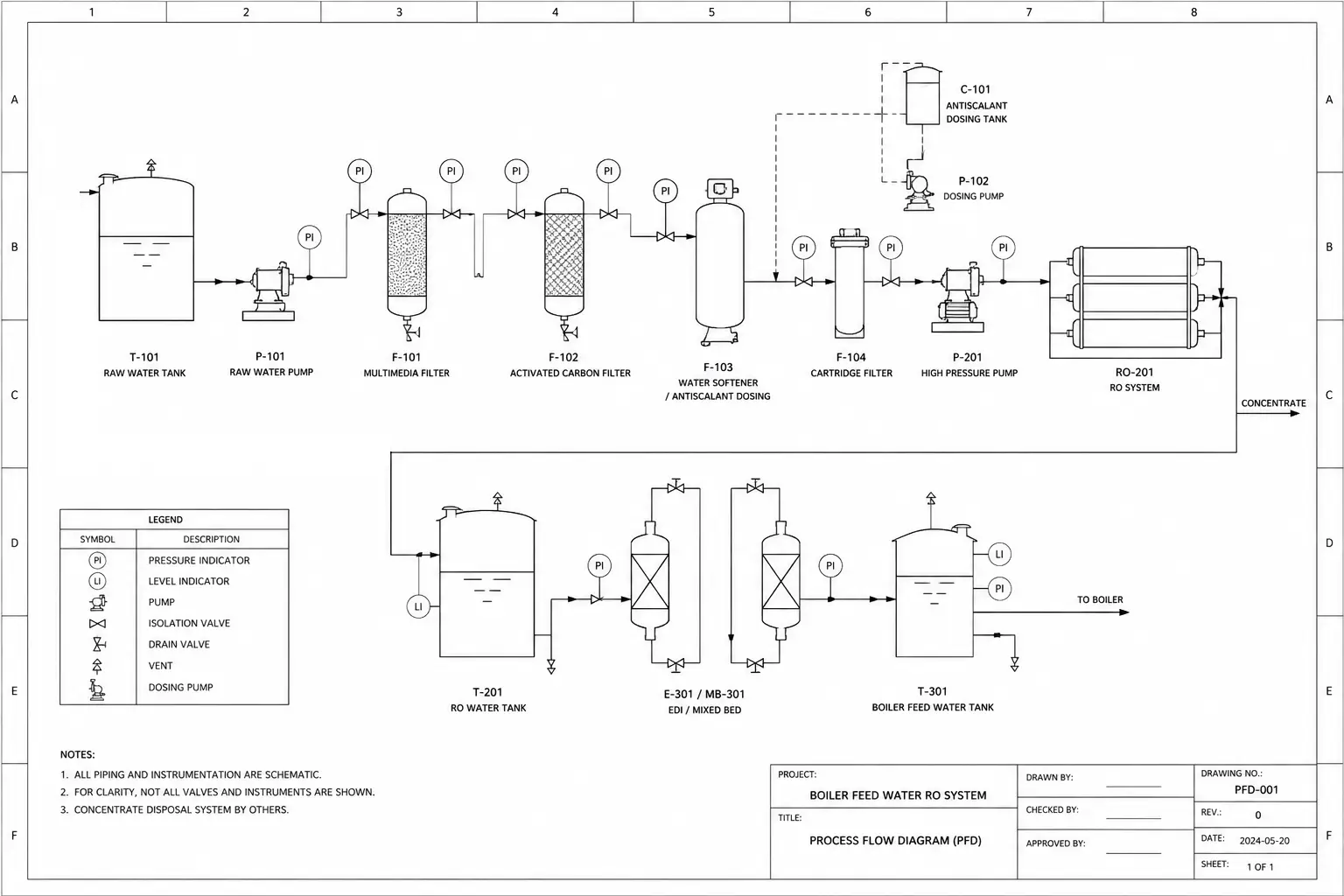
Raw Water Tank
→ Raw Water Pump
→ Multimedia Filter
→ Activated Carbon Filter
→ Water Softener or Antiscalant Dosing
→ Cartridge Filter
→ High Pressure Pump
→ RO System
→ RO Water Tank
→ EDI or Mixed Bed
→ Boiler Feed Water Tank
This is only a typical process. Your actual design may be different. If your raw water is municipal water with stable quality, the pretreatment may be simpler. If your water comes from a river, lake, well, or wastewater reuse system, you may need stronger pretreatment.
If your boiler requires very low conductivity or very low silica, you may need double-pass RO, EDI, mixed bed polishing, or additional degassing. If your site has limited space, you may choose a compact skid-mounted system or a containerized boiler feed water RO system.
Common Applications of Boiler Feed Water RO Systems
A boiler feed water treatment RO system can be used in many industrial sectors. If your production process depends on steam, hot water, heating, sterilization, drying, cleaning, or process heating, stable boiler make-up water treatment becomes important.
Common applications include:
Food and Beverage Factories
You need stable steam for sterilization, cleaning, cooking, and production. A reverse osmosis system for boiler feed water can help improve boiler water quality and reduce water-related production risks.
Textile Dyeing Plants
Textile plants often use large amounts of steam. Poor feed water quality can increase scaling and maintenance. An industrial RO system for boiler feed water can help reduce dissolved salts and support stable steam generation.
Chemical Plants
Chemical production often requires reliable steam and heating. You need a water treatment system that can handle industrial conditions and provide consistent make-up water quality.
Pharmaceutical Factories
Pharmaceutical production may require stable steam quality and reliable utility systems. Boiler feed water purification is part of a broader water quality management strategy.
Power Plants
Power plants usually have stricter requirements for boiler and turbine water quality. RO is often used before EDI or mixed bed polishing to produce higher purity water.
Paper Mills
Paper mills use steam for drying and production. A boiler feed water RO system can help reduce scaling, improve boiler operation, and lower water treatment pressure.
Oil and Gas Facilities
Oil and gas facilities may use steam for process heating, utility systems, and production support. A robust RO water treatment system can help handle demanding project conditions.
Industrial Parks
Industrial parks often serve multiple factories with different steam demands. A centralized boiler feed water treatment system can help improve reliability and reduce operating complexity.
How to Choose a Reliable Boiler Feed Water RO System Supplier
Choosing the right supplier is as important as choosing the right equipment. A boiler feed water RO project is not just a standard product purchase. It is an engineering decision.
When you compare suppliers, you should ask these questions:
Can the supplier design according to your water analysis report?
Can the supplier explain why each pretreatment step is needed?
Can the supplier design single-pass RO, double-pass RO, RO + EDI, or RO + mixed bed systems?
Can the supplier provide PFD drawings and technical documents?
Can the supplier customize the system based on your boiler room space?
Can the supplier provide PLC control and online monitoring?
Can the supplier support overseas installation and commissioning?
Can the supplier provide spare parts and membrane replacement support?
Can the supplier help you troubleshoot water quality problems after delivery?
A reliable supplier should not only quote a low price. The supplier should help you reduce project risk. For boiler feed water treatment, a low-price but poorly designed system may create higher costs later through membrane fouling, unstable water quality, frequent maintenance, and boiler problems.
With 20 years of experience in industrial water treatment equipment manufacturing, CM can provide customized RO systems for boiler feed water treatment. Your system can be designed with pretreatment, RO units, EDI or mixed bed polishing, control systems, technical documentation, and after-sales support for overseas projects.
FAQ About RO Systems for Boiler Feed Water Treatment
1. Is RO water suitable for boiler feed water?
Yes, RO water is widely used for boiler feed water treatment. It can reduce dissolved salts, hardness, TDS, and conductivity. However, whether RO alone is enough depends on your boiler pressure level and final water quality requirement. For higher purity requirements, you may need RO + EDI or RO + mixed bed polishing.
2. What is the best treatment system for boiler feed water?
The best treatment system depends on your raw water quality and boiler requirements. A common solution includes pretreatment, RO, storage tank, and final polishing. For more demanding applications, the system may include double-pass RO, EDI, mixed bed, degassing, and chemical conditioning.
3. Does RO remove hardness from boiler feed water?
Yes, RO can greatly reduce hardness from boiler make-up water. However, water softening may still be used before RO to protect the membranes and reduce scaling risk, especially when the raw water hardness is high.
4. Do you need double-pass RO for boiler feed water?
You need double-pass RO when single-pass RO cannot meet your required conductivity, TDS, or silica level. Low-pressure boilers may only need single-pass RO in some cases, while medium-pressure or high-pressure boilers may require double-pass RO or additional polishing.
5. Can RO reduce boiler blowdown?
RO can help reduce dissolved solids entering the boiler. When dissolved solids are lower, blowdown demand may be reduced. This can help lower treated water loss, heat loss, chemical usage, and wastewater discharge. Actual results depend on your boiler operation and water chemistry control.
6. What pretreatment is required before boiler feed water RO?
Pretreatment may include multimedia filtration, activated carbon filtration, water softening, antiscalant dosing, cartridge filtration, or ultrafiltration. The correct pretreatment depends on your raw water source, turbidity, hardness, chlorine, SDI, and scaling tendency.
7. How long do RO membranes last in boiler feed water systems?
RO membranes often last around 2–5 years in many industrial systems, but actual lifespan depends on feed water quality, pretreatment, operating pressure, recovery rate, cleaning frequency, and daily maintenance. Better pretreatment usually means better membrane protection.
8. What capacity RO system do you need for your boiler?
Your required RO capacity should be calculated based on actual make-up water demand, not only boiler size. You should consider boiler capacity, steam demand, operating hours, condensate recovery, blowdown rate, storage tank volume, and future expansion.
9. Is RO enough for high-pressure boilers?
For high-pressure boilers, RO alone may not be enough. You may need double-pass RO, EDI, mixed bed polishing, degassing, or additional chemical conditioning to reach the required feed water quality. The final design should follow your boiler manufacturer’s water quality requirements.
10. Can the system be customized for your boiler room?
Yes, a boiler feed water RO system can be customized according to your capacity, water quality, site space, automation level, power supply, and installation requirements. You can choose skid-mounted, compact, or containerized designs depending on your project conditions.
Conclusion
When you choose a boiler feed water treatment RO system, you should not only focus on the equipment price or rated capacity. You need to consider your raw water quality, boiler pressure level, required outlet water quality, pretreatment design, RO configuration, polishing system, automation, and long-term maintenance.
A properly designed reverse osmosis system for boiler feed water can help you reduce scaling risk, lower dissolved solids, improve boiler make-up water quality, reduce blowdown pressure, and support more stable steam system operation.
If you are planning a boiler feed water treatment project, send us your water analysis report, required capacity, boiler operating conditions, and target water quality. Our engineering team can help you design a suitable industrial RO system for boiler feed water based on your real project needs.
Need a Boiler Feed Water RO System for Your Project?
Send us your water analysis report, boiler capacity, required flow rate, and target water quality. CM can help you design a customized boiler feed water purification system for stable long-term operation.