
Seawater desalination is the process of converting high-salinity seawater into usable fresh water. A complete seawater desalination system must remove suspended solids, microorganisms, organic matter, dissolved salts, boron, hardness ions, and other impurities. In most modern projects, the seawater reverse osmosis system is the core desalination unit. However, SWRO must work together with intake, pretreatment, high-pressure pumping, energy recovery, post-treatment, disinfection, and brine discharge.
Why Seawater Needs a Complete Desalination Process
Seawater contains a very high level of dissolved salts. Typical seawater has a salinity of about 35,000 mg/L as TDS, but the actual value can change depending on location, evaporation, rainfall, river inflow, coastal pollution, and seasonal conditions.
Compared with river water or groundwater, seawater has much higher chloride, sodium, magnesium, sulfate, calcium, potassium, bromide, boron, and total dissolved solids. It may also contain suspended solids, algae, microorganisms, organic matter, oil, silt, and marine debris.
Because of this, seawater cannot be treated by simple filtration alone. A sand filter may remove suspended particles, but it cannot remove dissolved salts. Activated carbon may improve odor and remove chlorine, but it cannot remove most seawater salinity. Disinfection can kill microorganisms, but it cannot turn seawater into fresh water.
This is why reverse osmosis is so important in seawater desalination. The seawater reverse osmosis system, also called SWRO system, uses high pressure to push seawater through semi-permeable membranes. Water molecules pass through the membrane, while most dissolved salts and ions are rejected and discharged as concentrated brine.
However, SWRO membranes are sensitive to fouling, scaling, oxidation, and poor pretreatment. If raw seawater is sent directly into the RO membranes, the system will quickly face high pressure, low flow, poor salt rejection, and frequent cleaning. Therefore, a reliable seawater desalination plant must be designed as a complete process, not only an RO machine.
Typical Seawater Desalination System Flow
A complete seawater desalination system usually includes the following process:
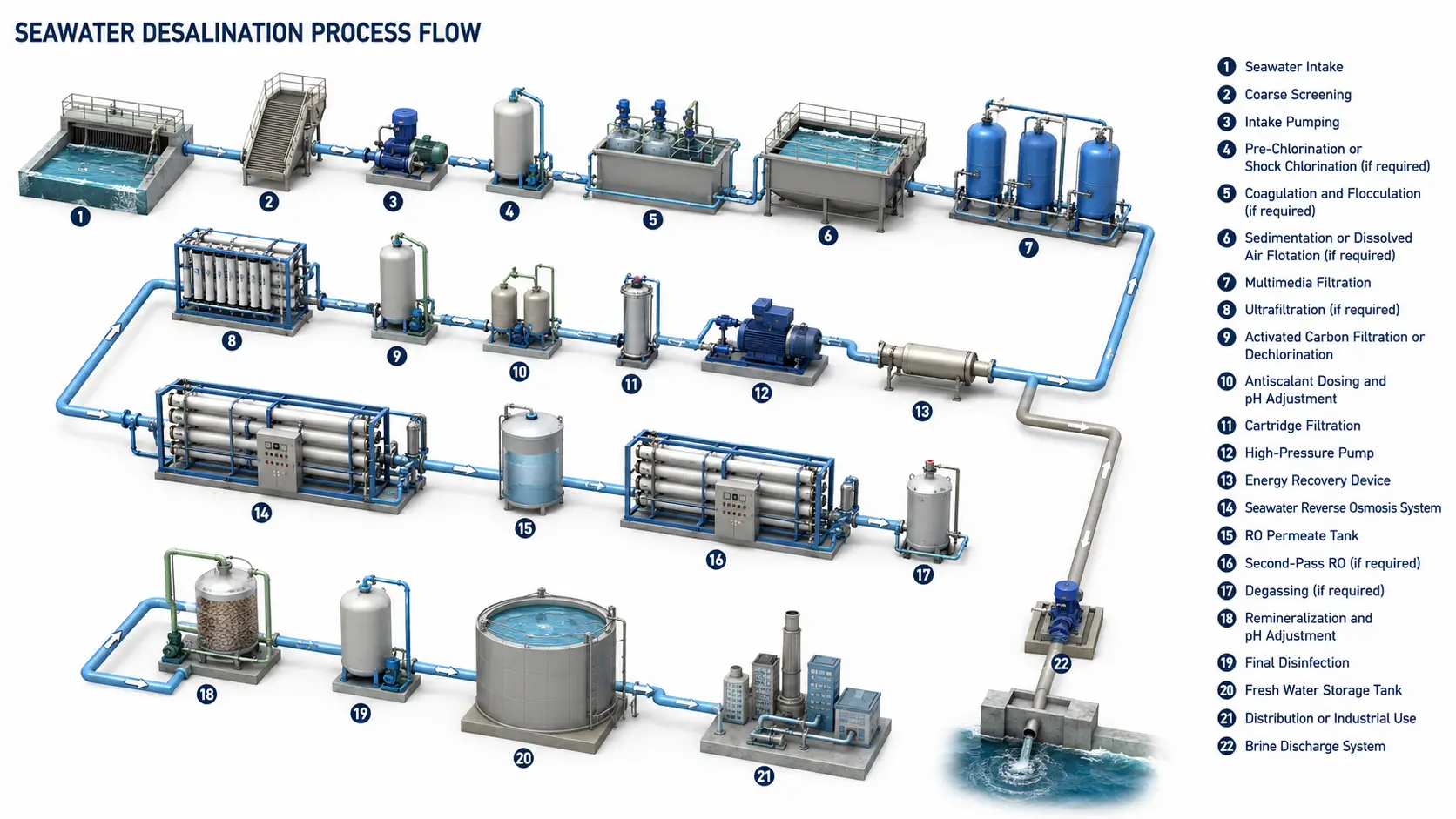
Seawater Intake
→ Coarse Screening
→ Intake Pumping
→ Pre-Chlorination or Shock Chlorination, if required
→ Coagulation and Flocculation, if required
→ Sedimentation or Dissolved Air Flotation, if required
→ Multimedia Filtration
→ Ultrafiltration, if required
→ Activated Carbon Filtration or Dechlorination
→ Antiscalant Dosing and pH Adjustment
→ Cartridge Filtration
→ High-Pressure Pump
→ Energy Recovery Device
→ Seawater Reverse Osmosis System
→ RO Permeate Tank
→ Second-Pass RO, if required
→ Degassing, if required
→ Remineralization and pH Adjustment
→ Final Disinfection
→ Fresh Water Storage Tank
→ Distribution or Industrial Use
→ Brine Discharge System
The final process depends on raw seawater quality, plant capacity, target water quality, required recovery rate, available space, energy cost, local environmental regulations, and whether the system is fixed, skid-mounted, or containerized.
Step 1: Seawater Intake
The first step is collecting seawater from the ocean. The intake system has a major impact on pretreatment design, membrane fouling risk, and long-term operation stability.
There are two common seawater intake methods:
Open Seawater Intake
Open intake takes seawater directly from the sea through intake pipes, screens, and pumps. It is suitable for larger desalination plants, but it may bring in algae, fish, sand, shells, organic matter, oil, and suspended solids. Therefore, open intake usually requires stronger pretreatment.
Beach Well or Subsurface Intake
Beach well intake draws seawater through sand or coastal aquifers. The natural filtration effect of sand can reduce turbidity, algae, and suspended solids. This can improve RO feed water stability, but it may not be suitable for every site because it depends on coastal geology and available land.
Main Design Points
A seawater intake system should consider:
- Intake location
- Seawater depth
- Marine life protection
- Sand and silt load
- Algae bloom risk
- Oil pollution risk
- Tidal changes
- Pumping distance
- Intake screen design
- Maintenance access
Typical Raw Seawater Parameters
| Parameter | Typical Seawater Reference Range |
|---|---|
| TDS | 30,000–45,000 mg/L |
| Salinity | Around 35 ppt in many open ocean areas |
| Conductivity | 45,000–60,000 μS/cm |
| pH | 7.8–8.3 |
| Chloride | 18,000–22,000 mg/L |
| Sodium | 10,000–12,000 mg/L |
| Sulfate | 2,500–3,000 mg/L |
| Calcium | 350–450 mg/L |
| Magnesium | 1,200–1,400 mg/L |
| Boron | 4–6 mg/L |
| Turbidity | <1–20 NTU, depending on location |
| SDI15 | Variable, often high without pretreatment |
| Temperature | 5–35°C, depending on location |
| Microorganisms | Usually present |
| Algae | Seasonal risk |
These are general engineering reference ranges. A real seawater desalination project must be designed based on actual seawater analysis and seasonal variation.
Step 2: Coarse Screening and Fine Screening
After intake, seawater first passes through screens. Screening removes large physical impurities and protects pumps, pipes, valves, filters, and membranes.
Coarse screens remove large debris, such as seaweed, plastic, shells, stones, leaves, and marine organisms. Fine screens remove smaller particles and reduce the loading on downstream equipment.
Main Control Parameters
| Parameter | Common Reference |
|---|---|
| Coarse screen opening | 5–20 mm |
| Fine screen opening | 1–5 mm |
| Screen cleaning | Manual or automatic |
| Head loss | Continuously monitored |
| Flow capacity | Based on plant design |
| Debris load | Depends on intake location |
Screening does not remove dissolved salts or microorganisms. Its main role is mechanical protection.
Step 3: Intake Pumping
After screening, intake pumps transfer seawater to the pretreatment system. The intake pump must provide stable flow to downstream units.
The pump design should consider:
- Seawater corrosion resistance
- Flow rate
- Pump head
- Variable-frequency control
- Intake water level fluctuation
- Energy consumption
- Spare pump arrangement
- Maintenance access
In seawater projects, material selection is important because chloride concentration is very high. Pumps, valves, pipes, and fasteners should be selected for seawater corrosion resistance.
Step 4: Pre-Chlorination or Shock Chlorination, If Required
Seawater contains bacteria, algae, and marine microorganisms. Biological growth can block filters and foul RO membranes. Pre-chlorination or shock chlorination may be used to control biological activity in the intake and pretreatment system.
However, chlorine must not enter most polyamide RO membranes. Free chlorine can oxidize the RO membrane and reduce salt rejection. Therefore, if chlorine is used before the RO system, it must be removed before the water enters the RO membranes.
Main Control Parameters
| Parameter | Common Control Point |
|---|---|
| Chlorine dosage | Based on biological growth risk |
| Contact time | Based on site design |
| ORP | Monitored if required |
| Biofouling control | Key objective |
| Free chlorine before RO | Nearly 0 mg/L |
| Dechlorination | Required before RO if chlorine is used |
For some projects, continuous chlorination is avoided and periodic shock dosing is used instead. The best approach depends on raw seawater biology and membrane protection strategy.
Step 5: Coagulation and Flocculation, If Required
If seawater contains high turbidity, colloids, algae, or organic matter, coagulation and flocculation may be needed before filtration.
Coagulation adds chemicals to destabilize fine particles and colloids. Flocculation uses slow mixing to form larger flocs that can be removed by sedimentation, DAF, or filtration.
Common coagulants include ferric chloride, PAC, aluminum salts, or special seawater coagulants.
Main Control Parameters
| Parameter | Common Reference |
|---|---|
| Coagulant dosage | Usually determined by jar test |
| pH | Controlled for coagulation performance |
| Mixing intensity | Rapid mixing for coagulation |
| Flocculation time | 10–30 minutes |
| Floc size | Stable flocs preferred |
| Algae removal | Important during bloom seasons |
| Turbidity reduction | Monitored |
Coagulation is not required in every seawater desalination system. Clean subsurface intake water may need simpler pretreatment. Open intake seawater often needs stronger pretreatment.
Step 6: Sedimentation or Dissolved Air Flotation
After coagulation and flocculation, the system may use sedimentation or dissolved air flotation.
Sedimentation
Sedimentation removes heavier flocs by gravity. It is useful when particles settle well and the plant has enough space.
Dissolved Air Flotation
Dissolved air flotation, or DAF, is very useful when seawater contains algae, low-density particles, or organic matter. Fine air bubbles attach to flocs and float them to the surface for removal.
DAF is commonly considered in seawater desalination projects where algae bloom risk is high.
Main Control Parameters
| Parameter | Common Reference |
|---|---|
| Surface loading rate | Based on design |
| Sludge removal | Required |
| Settled water turbidity | Monitored |
| DAF recycle ratio | Controlled if DAF is used |
| Algae removal | Important |
| Chemical dosing | Adjusted by raw water quality |
This step reduces the load on downstream filters and improves the stability of RO pretreatment.
Step 7: Multimedia Filtration
Multimedia filtration is a common pretreatment step in seawater desalination. It removes suspended solids, flocs, turbidity, and some particulate matter.
A multimedia filter may contain anthracite, quartz sand, and gravel layers. It can be designed as a pressure filter or gravity filter, depending on plant size and layout.
Main Control Parameters
| Parameter | Common Reference |
|---|---|
| Inlet turbidity | Depends on upstream treatment |
| Outlet turbidity | Usually <1 NTU, lower preferred |
| Filtration rate | Based on design |
| Pressure drop | Monitored |
| Backwash frequency | Based on turbidity and pressure drop |
| SDI reduction | Important for RO protection |
| Backwash water | Required |
For SWRO systems, multimedia filtration alone may not always provide stable feed water, especially with open intake seawater. In many modern systems, ultrafiltration is used after or instead of conventional media filtration.
Step 8: Ultrafiltration, If Required
Ultrafiltration is widely used as advanced pretreatment before seawater reverse osmosis. UF membranes can remove suspended solids, colloids, bacteria, algae, and many microorganisms.
UF provides more stable RO feed water quality than conventional filtration alone. This is especially useful for seawater with seasonal turbidity changes, algae bloom risk, or high biological activity.
Main Control Parameters
| Parameter | Common Reference |
|---|---|
| UF permeate turbidity | Often <0.1 NTU when well operated |
| SDI15 | Usually targeted <3 before RO |
| Transmembrane pressure | Monitored |
| Flux | Based on seawater quality |
| Backwash frequency | Automatic backwash |
| Chemical enhanced backwash | Used if required |
| CIP frequency | Based on TMP increase |
| Integrity test | Recommended in critical projects |
UF is not mandatory for every SWRO project, but it can greatly improve membrane protection and reduce operational risk.
Step 9: Activated Carbon Filtration or Dechlorination
If chlorine is used upstream, it must be removed before the RO membranes. Activated carbon filtration or chemical dechlorination is commonly used.
Activated carbon can remove free chlorine, some organic matter, taste, and odor. Chemical dechlorination usually uses sodium bisulfite or similar reducing agents.
Main Control Parameters
| Parameter | Common Reference |
|---|---|
| Free chlorine before RO | Nearly 0 mg/L |
| ORP | Monitored if required |
| Sodium bisulfite dosage | Based on chlorine residual |
| Activated carbon pressure drop | Monitored |
| Carbon backwash | Required |
| Biological growth | Must be controlled |
Dechlorination is critical. If free chlorine reaches the RO membranes, it can cause irreversible membrane damage and reduce system performance.
Step 10: Antiscalant Dosing and pH Adjustment
Seawater contains calcium, magnesium, sulfate, carbonate, bicarbonate, barium, strontium, and silica. During RO operation, salts become more concentrated on the brine side. This can create scaling risk.
Antiscalant dosing helps reduce scaling inside RO membranes. pH adjustment may also be used to control carbonate scaling and improve system stability.
Main Control Parameters
| Parameter | Common Control Point |
|---|---|
| Antiscalant dosage | Based on scaling calculation |
| pH before RO | Usually controlled according to membrane and scaling design |
| LSI / scaling index | Checked during design |
| Calcium sulfate risk | Calculated |
| Barium / strontium sulfate risk | Calculated if present |
| Silica risk | Checked |
| Recovery rate | Designed with scaling control |
Recovery rate and antiscalant dosing must be designed together. A high recovery rate may reduce brine discharge volume, but it increases scaling risk.
Step 11: Cartridge Filtration
A cartridge filter is installed before the high-pressure pump and RO membranes. It acts as the final safety barrier before the SWRO system.
Common cartridge filter ratings are 1–5 microns. The cartridge filter removes fine particles that may pass through upstream pretreatment.
Main Control Parameters
| Parameter | Common Reference |
|---|---|
| Filter rating | 1–5 μm |
| Differential pressure | Monitored |
| Replacement frequency | Based on pressure drop |
| SDI15 before RO | Preferably <3 |
| Turbidity before RO | Preferably <0.1–0.5 NTU |
| Filter housing material | Seawater-resistant material |
Cartridge filtration cannot replace strong pretreatment. It is only the final protection before RO.
Step 12: High-Pressure Pump
The high-pressure pump is one of the most important components in a seawater desalination system. Seawater RO requires much higher pressure than brackish water RO because seawater has much higher osmotic pressure.
A high-pressure pump pushes pretreated seawater into the RO membrane system. The pressure must be high enough to overcome osmotic pressure and drive water through the membrane.
Main Operating Parameters
| Parameter | Common Reference |
|---|---|
| SWRO operating pressure | Often 55–70 bar, depending on salinity and temperature |
| Pump material | Duplex stainless steel or suitable seawater-resistant material |
| Flow control | Often with VFD |
| Energy efficiency | Very important |
| Vibration and noise | Monitored |
| Spare pump design | Based on project requirement |
Because the high-pressure pump consumes a large part of system energy, pump selection directly affects operating cost.
Step 13: Energy Recovery Device
Energy recovery is very important in seawater desalination. The RO concentrate leaves the membrane system at high pressure. Instead of wasting this pressure energy, an energy recovery device transfers part of it back to the incoming seawater.
Common energy recovery devices include pressure exchangers, turbochargers, or hydraulic turbines.
Main Benefits
Energy recovery can help:
- Reduce high-pressure pump power demand
- Lower specific energy consumption
- Reduce operating cost
- Improve system efficiency
- Make large SWRO plants more economical
Main Control Parameters
| Parameter | Common Control Point |
|---|---|
| Energy recovery efficiency | Higher is better |
| Brine pressure | Monitored |
| Feed pressure | Monitored |
| Flow balance | Important |
| Pressure exchanger performance | Checked |
| Maintenance condition | Critical for efficiency |
For seawater desalination projects, energy recovery is usually a key design consideration, especially for medium and large systems.
Step 14: Seawater Reverse Osmosis System
The seawater reverse osmosis system is the core desalination unit. It removes most dissolved salts and produces low-salinity permeate water.
Inside the SWRO system, pretreated seawater enters membrane pressure vessels. Under high pressure, water passes through the RO membrane. Most salts are rejected and leave as concentrate.
What SWRO Removes
A properly designed SWRO system can reduce:
- TDS
- Conductivity
- Sodium
- Chloride
- Sulfate
- Calcium
- Magnesium
- Potassium
- Hardness
- Nitrate
- Fluoride
- Heavy metals
- Many dissolved ions
- Some organic micropollutants
- Boron, with proper membrane and pH control
Main SWRO Operating Parameters
| Parameter | Common Reference |
|---|---|
| Feed TDS | 30,000–45,000 mg/L typical seawater |
| Operating pressure | Often 55–70 bar |
| Recovery rate | Commonly 35–50% |
| Salt rejection | Often >99% depending on membrane |
| Permeate TDS | Often <500 mg/L for drinking water design, depending on system |
| Feed pH | Designed based on scaling and boron control |
| Temperature | Affects pressure and permeate flow |
| Differential pressure | Indicates fouling or blockage |
| Permeate conductivity | Key quality indicator |
| CIP frequency | Based on performance decline |
Why SWRO Is the Core Step
Pretreatment makes seawater clean enough for membranes, but pretreatment does not remove most dissolved salts. SWRO is the step that actually converts seawater into fresh water.
Without SWRO, the system may remove turbidity, algae, suspended solids, and microorganisms, but the water would still be salty. SWRO is the key barrier for sodium chloride and other dissolved ions.
Step 15: Second-Pass RO, If Required
In some projects, single-pass SWRO permeate may not meet the final water requirement. This can happen when very low TDS, low conductivity, or low boron is required.
A second-pass RO system treats the permeate from the first SWRO stage. It can further reduce dissolved salts, conductivity, and boron.
When Second-Pass RO May Be Needed
Second-pass RO may be used for:
- Drinking water with strict boron limits
- Industrial process water
- Boiler feed water
- Power plant water
- High-purity water pretreatment
- Hotels or islands requiring better taste and lower salinity
- Bottled water production
Main Control Parameters
| Parameter | Common Control Point |
|---|---|
| First-pass permeate TDS | Determines second-pass need |
| Boron level | Important for drinking water and irrigation |
| pH adjustment before second pass | Often used for boron removal |
| Second-pass recovery | Based on design |
| Final conductivity | Monitored |
| Blending ratio | Adjusted if blending is used |
Not every seawater desalination system needs second-pass RO. It depends on the final water quality target.
Step 16: Degassing, If Required
After RO, dissolved gases such as carbon dioxide may remain in the permeate. Degassing may be used to remove CO₂ and improve pH stability.
Degassing is especially useful when the system requires stable pH, lower chemical consumption, or downstream polishing.
Common degassing methods include:
- Degassing tower
- Membrane degasser
- Vacuum degassing
- Air stripping
Main Control Parameters
| Parameter | Common Control Point |
|---|---|
| CO₂ concentration | Tested if required |
| pH after degassing | Monitored |
| Air flow | Controlled |
| Degassing efficiency | Checked |
| Biological protection | Needed for tower systems |
Degassing is optional and depends on system design.
Step 17: Remineralization and pH Adjustment
RO permeate from seawater desalination is very low in minerals and alkalinity. It may taste flat and may be corrosive to pipelines and storage tanks. Therefore, post-treatment is required before the water is used as drinking water.
Remineralization adds calcium, magnesium, alkalinity, or other minerals back into the water. pH adjustment improves water stability and taste.
Common methods include:
- Calcite filter
- Limestone contactor
- Dolomite filter
- Lime dosing
- Carbon dioxide dosing
- Soda ash dosing
- Caustic soda dosing
- Blending with treated water, if allowed
Typical Final Drinking Water Targets
| Parameter | Common Target Range |
|---|---|
| pH | 6.5–8.5 |
| TDS | Often 100–500 mg/L, based on local standard and taste |
| Hardness | Adjusted for taste and corrosion control |
| Alkalinity | Adjusted for stability |
| Chloride | Usually below local drinking water limit |
| Sulfate | Usually below local drinking water limit |
| Boron | Based on local standard |
| Free chlorine residual | Based on distribution requirement |
The goal of remineralization is not to make ultra-pure water. The goal is to make stable, safe, and acceptable drinking water.
Step 18: Final Disinfection
Final disinfection protects product water before storage and distribution. Common disinfection methods include UV, sodium hypochlorite, chlorine dioxide, ozone, or a combination of methods.
UV can inactivate microorganisms without adding chemicals, but it does not provide residual protection. Chlorination provides residual disinfectant in the storage tank and distribution network.
Main Control Parameters
| Parameter | Common Control Point |
|---|---|
| UV dose | Based on design |
| Free chlorine residual | Often 0.2–0.5 mg/L in distribution, depending on local regulations |
| Contact time | Must be sufficient |
| pH | Affects chlorine performance |
| Turbidity | Should be very low |
| E. coli | Not detectable in final drinking water |
| Total coliform | Follow local regulation |
Disinfection must be controlled carefully to protect microbial safety and avoid excessive disinfection by-products.
Step 19: Fresh Water Storage and Distribution
After post-treatment and disinfection, the product water enters the fresh water storage tank. From there, it can be sent to the distribution network, industrial process, hotel, island community, boiler system, or irrigation system.
The storage tank must prevent secondary contamination.
Main Control Parameters
| Parameter | Control Requirement |
|---|---|
| Tank material | Suitable for drinking water |
| Tank design | Closed and clean |
| Vent filter | Recommended |
| Water level | Automatically controlled |
| Free chlorine residual | Monitored |
| Microbial testing | Regular testing |
| Cleaning schedule | Required |
| Distribution pressure | Stable |
| Water age | Controlled |
A seawater desalination plant does not end at the RO unit. Storage and distribution are also important for final water quality.
Step 20: Brine Discharge System
SWRO produces two streams: permeate and concentrate. The permeate becomes product water. The concentrate, also called brine, contains the rejected salts and must be discharged or further treated properly.
Brine discharge is an important environmental design point.
Common Brine Management Methods
- Direct ocean discharge with diffuser
- Mixing with cooling water discharge
- Evaporation pond
- Further concentration
- Salt recovery, in special projects
- Zero liquid discharge, if required
Main Control Parameters
| Parameter | Control Requirement |
|---|---|
| Brine salinity | Monitored |
| Discharge flow | Controlled |
| Temperature | Checked if relevant |
| Chemical residual | Controlled |
| Antiscalant residual | Considered |
| Marine impact | Evaluated |
| Diffuser design | Important for dilution |
| Local permit | Must be followed |
Good brine discharge design helps reduce environmental impact and comply with local regulations.
Key Water Quality Parameters in Seawater Desalination
The following table gives general engineering reference values. Final design must be based on actual seawater analysis and local drinking water or industrial water standards.
| Parameter | Raw Seawater Concern | Target Before SWRO | Final Product Water Target |
|---|---|---|---|
| TDS | High salinity | 30,000–45,000 mg/L feed | Often <500 mg/L for drinking water |
| Conductivity | Dissolved salts | High in seawater | Based on target quality |
| Turbidity | Fouling risk | <0.1–0.5 NTU preferred | Very low |
| SDI15 | Membrane fouling risk | <3 preferred | Not final parameter |
| pH | Scaling and membrane performance | Usually controlled around neutral range | 6.5–8.5 commonly used |
| Free chlorine | RO membrane damage | Nearly 0 mg/L before RO | Residual after final disinfection |
| Iron | Fouling and staining | <0.1 mg/L preferred | Low |
| Manganese | Fouling and staining | <0.05 mg/L preferred | Low |
| Oil and grease | Membrane fouling | Not detectable | Not acceptable |
| Boron | Drinking water and irrigation concern | Reduced by RO and second pass if needed | Based on local standard |
| Chloride | Salinity and taste | Reduced by RO | Based on drinking water standard |
| Sulfate | Taste and scaling | Reduced by RO | Based on drinking water standard |
| Hardness | Scaling | Controlled by RO and antiscalant | Adjusted by remineralization |
| E. coli | Microbial safety | Controlled by disinfection | Not detectable |
| Free chlorine residual | Distribution protection | Not allowed before RO | Required after final disinfection if chlorinated |
The Main Role of Reverse Osmosis in Seawater Desalination
The seawater reverse osmosis system is the heart of the desalination plant. Every step before RO is mainly designed to protect the membrane. Every step after RO is designed to make the permeate stable, safe, and suitable for use.
1. SWRO Removes Dissolved Salts
The main purpose of SWRO is to remove sodium chloride and other dissolved salts from seawater. This is what turns seawater into fresh water.
2. SWRO Reduces Conductivity and TDS
Seawater has extremely high conductivity and TDS. SWRO reduces these values to a level suitable for drinking water, industrial process water, or further polishing.
3. SWRO Provides a Strong Separation Barrier
RO membranes separate water from dissolved ions. This makes SWRO more effective than conventional filtration for salinity reduction.
4. SWRO Reduces Many Chemical Contaminants
Depending on membrane type and operating conditions, SWRO can reduce nitrate, fluoride, arsenic, heavy metals, boron, sulfate, chloride, and many dissolved contaminants.
5. SWRO Makes Seawater a Reliable Water Source
For islands, coastal cities, hotels, ships, offshore platforms, and industrial parks, seawater desalination can provide a stable water source where freshwater is limited.
Common Applications of Seawater Desalination Systems
Seawater desalination systems can be used in many applications:
- Municipal drinking water supply
- Island water supply
- Coastal hotels and resorts
- Containerized seawater desalination plants
- Offshore platforms
- Ships and marine vessels
- Power plants
- Industrial process water
- Boiler feed water pretreatment
- Mining camps
- Construction camps
- Emergency water supply
- Agriculture and greenhouse irrigation, with proper boron control
For remote coastal projects, containerized seawater desalination systems are often preferred because they are easier to transport, install, and operate.
What Information Should You Provide Before Requesting a Seawater Desalination Proposal?
To design a suitable seawater desalination system, you should provide:
- Seawater analysis report
- Intake type: open intake or beach well
- Required product water capacity
- Daily operating hours
- Target water quality
- Drinking water or industrial water standard
- Seawater temperature range
- Seasonal turbidity and algae risk
- Available power supply
- Installation location
- Available space
- Brine discharge conditions
- Required recovery rate
- Whether containerized design is needed
- Automation requirements
- Material requirements
- Final disinfection requirements
- Whether second-pass RO is required
- Whether remineralization is required
If you do not have a complete seawater analysis report, you should test the water before final system design. At minimum, the report should include TDS, conductivity, pH, turbidity, SDI, chloride, sulfate, calcium, magnesium, sodium, potassium, boron, iron, manganese, silica, alkalinity, TOC or COD, oil and grease, and microbiological indicators.
FAQ About Seawater Desalination Systems
1. What is a seawater desalination system?
A seawater desalination system is a water treatment system that removes salt and impurities from seawater to produce fresh water. In most modern systems, seawater reverse osmosis is the main desalination technology.
2. Why is reverse osmosis used for seawater desalination?
Reverse osmosis is used because it can remove most dissolved salts from seawater. Conventional filters can remove particles and turbidity, but they cannot effectively remove sodium chloride and other dissolved ions. SWRO is the key step that converts seawater into usable fresh water.
3. What is the complete process of seawater desalination?
A complete seawater desalination process usually includes seawater intake, screening, pretreatment, filtration or UF, dechlorination, antiscalant dosing, cartridge filtration, high-pressure pumping, energy recovery, SWRO membranes, post-treatment, remineralization, disinfection, storage, and brine discharge.
4. What pretreatment is needed before SWRO?
Pretreatment may include screening, coagulation, flocculation, sedimentation or DAF, multimedia filtration, ultrafiltration, activated carbon filtration, dechlorination, antiscalant dosing, pH adjustment, and cartridge filtration. The exact pretreatment depends on seawater quality and intake type.
5. What pressure does a seawater RO system need?
Seawater RO usually requires much higher pressure than brackish water RO. Many SWRO systems operate around 55–70 bar, depending on salinity, temperature, membrane type, recovery rate, and system design.
6. Why is energy recovery important in seawater desalination?
Energy recovery is important because SWRO requires high pressure. The brine leaving the RO system still contains pressure energy. An energy recovery device transfers part of this energy back to the incoming seawater, reducing power consumption and operating cost.
7. Does SWRO permeate need post-treatment?
Yes. SWRO permeate is usually low in minerals and alkalinity. For drinking water, it often needs remineralization, pH adjustment, and final disinfection before storage and distribution. This improves taste, stability, and corrosion control.
8. What happens to the brine from seawater desalination?
The brine contains rejected salts and must be discharged or treated properly. Common options include ocean discharge with diffusers, mixing with other discharge streams, evaporation ponds, further concentration, or zero liquid discharge in special projects. Brine management must follow local environmental regulations.
Conclusion
A seawater desalination system is not just an RO machine. It is a complete water treatment process that includes intake, screening, pretreatment, membrane desalination, energy recovery, post-treatment, disinfection, storage, and brine management.
The seawater reverse osmosis system is the core of the process. It removes dissolved salts, reduces TDS and conductivity, and produces fresh water from seawater. However, SWRO can only operate reliably when it is protected by proper pretreatment and supported by correct post-treatment.
If you are planning a seawater desalination project, you should start with seawater analysis, capacity requirements, target water quality, intake conditions, energy cost, and brine discharge requirements. CM can help you design a complete seawater desalination system with pretreatment, SWRO, energy recovery, remineralization, disinfection, and skid-mounted or containerized equipment options.