
1. What Is Nanofiltration (NF)?
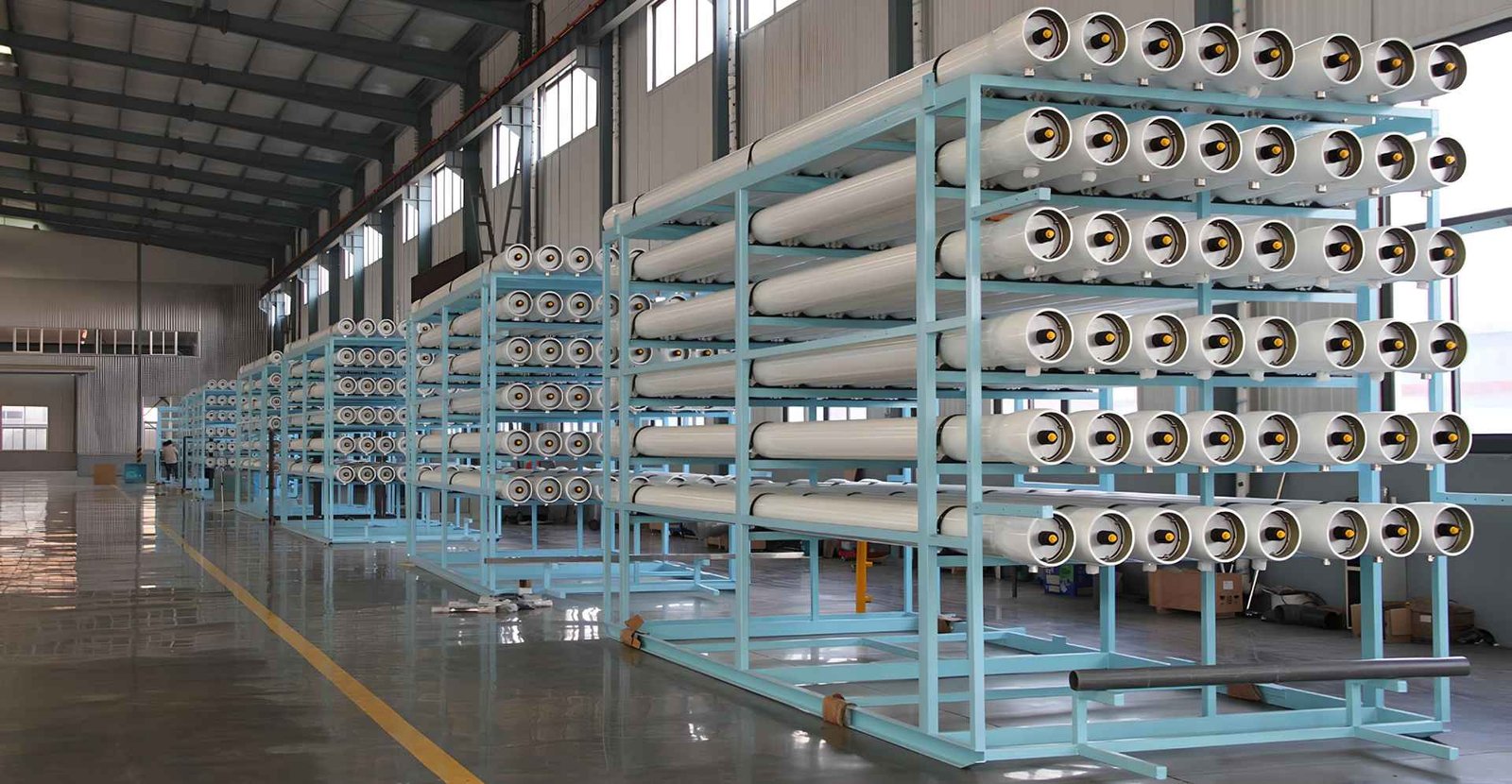
Nanofiltration (NF) is a pressure-driven membrane separation technology positioned between ultrafiltration (UF) and reverse osmosis (RO).
It is widely used in industrial water treatment when selective ion removal is required — particularly for:
- Divalent ion removal (Ca²⁺, Mg²⁺, SO₄²⁻)
- Partial desalination
- Organic matter separation
- Color removal
- Softening without full demineralization
Unlike RO, nanofiltration allows partial passage of monovalent salts (NaCl) while rejecting hardness and large organic molecules. This makes NF highly energy-efficient compared to full desalination systems.
2. How Does a Nanofiltration Membrane Work?
NF membranes operate based on three core mechanisms:
2.1 Size Exclusion (Molecular Sieving)
Typical Molecular Weight Cut-Off (MWCO):
200–1000 Daltons
This allows removal of:
- Natural organic matter (NOM)
- Pesticides
- Dye molecules
- Large organic compounds
2.2 Electrostatic Repulsion (Donnan Effect)
NF membranes are typically negatively charged.
This causes strong rejection of:
- Calcium (Ca²⁺)
- Magnesium (Mg²⁺)
- Sulfate (SO₄²⁻)
While allowing partial passage of:
- Sodium (Na⁺)
- Chloride (Cl⁻)
2.3 Operating Pressure
| Technology | Typical Pressure |
|---|---|
| UF | 1–3 bar |
| NF | 4–12 bar |
| RO | 10–70 bar |
NF consumes significantly less energy than RO in brackish applications.
3. Nanofiltration vs Reverse Osmosis (Engineering Perspective)
| Parameter | NF | RO |
|---|---|---|
| Salt rejection | 50–90% | 95–99.7% |
| Hardness removal | High | Very high |
| Monovalent salt removal | Partial | Almost complete |
| Operating pressure | Medium | High |
| Energy consumption | Lower | Higher |
| Typical use | Softening, partial desalination | Full desalination |
When to choose NF instead of RO:
- When TDS reduction is not required to ultra-low levels
- When hardness removal is the primary goal
- When energy optimization is critical
- When downstream process tolerates some sodium
4. Structure of an Industrial Nanofiltration System
A complete NF system typically includes:
4.1 Pretreatment Section
Critical for membrane protection:
- Multimedia filter
- Activated carbon filter
- Cartridge filter (5 μm)
- Antiscalant dosing
- pH adjustment (if required)
4.2 High-Pressure Pump
Provides operating pressure (4–12 bar).
Pump selection depends on:
- Recovery rate
- Membrane configuration
- Feed water quality
4.3 NF Membrane Module
Common configurations:
- Spiral wound (8-inch industrial elements)
- Pressure vessel housing
- Multi-stage array (e.g., 2:1, 3:2 design)
4.4 CIP Cleaning System
Includes:
- Cleaning tank
- Circulation pump
- Heater (optional)
- Chemical dosing
4.5 Control System
- Flow meters
- Pressure gauges
- Conductivity meters
- PLC automation
5. Key Design Parameters for NF System
5.1 Recovery Rate
Typical industrial range:
65% – 85%
Depends on:
- Feed TDS
- Scaling potential
- Design configuration
5.2 Flux Rate
Typical design flux:
15–30 L/m²·h
High flux increases fouling risk.
5.3 Feed Water Requirements
Recommended limits:
- SDI < 3
- Turbidity < 1 NTU
- Iron < 0.1 ppm
- Free chlorine: 0 ppm
5.4 Scaling Control
NF membranes are more prone to sulfate scaling.
Control methods:
- Antiscalant dosing
- pH adjustment
- Lower recovery design
6. Industrial Applications of Nanofiltration
NF is widely used across multiple industries.
6.1 Industrial Wastewater Treatment
- Dye wastewater
- Electroplating wastewater
- Textile industry
- Chemical process water
Benefits:
- COD reduction
- Color removal
- Partial desalination
- Reuse preparation
6.2 Water Softening
NF provides chemical-free softening alternative to ion exchange.
Removes:
- Ca²⁺
- Mg²⁺
- Sulfate
Common in:
- Boiler feed pretreatment
- Cooling tower makeup
- Process water conditioning
6.3 Food & Beverage Industry
Used for:
- Sugar concentration
- Dairy processing
- Juice clarification
- Color removal
6.4 Pharmaceutical Industry
- API concentration
- Organic solvent recovery
- Process water purification
6.5 Surface Water Treatment
- Natural organic matter removal
- THM precursor reduction
- Pesticide removal
7. Common Problems and Solutions in NF Systems
7.1 Membrane Fouling
Types:
- Organic fouling
- Biofouling
- Scaling
- Colloidal fouling
Prevention:
- Proper pretreatment
- Scheduled CIP
- Flux optimization
7.2 Flux Decline
Caused by:
- Concentration polarization
- Improper recovery design
Solution:
- Optimize stage ratio
- Adjust crossflow velocity
7.3 Membrane Lifetime
Typical lifespan:
3–5 years
Depends on:
- Feed quality
- Cleaning frequency
- Operating pressure
8. Containerized and Customized Nanofiltration Systems
Modern industrial projects increasingly require:
- Skid-mounted NF systems
- Containerized treatment plants
- Fully automated PLC control
- Remote monitoring
Customized design is required based on:
- Feed water analysis
- Target permeate standard
- Installation space
- Energy optimization requirements
9. How to Select the Right Nanofiltration System?
Before system design, the following data is required:
- Full water analysis report
- Daily flow capacity
- Recovery target
- Discharge standard
- Installation environment
Engineering simulation and pilot testing are recommended for complex wastewater projects.
10. Why Choose an Industrial-Grade NF System?
Compared with standard commercial systems, industrial-grade NF systems offer:
- Higher structural strength
- Optimized array configuration
- Advanced automation
- Lower long-term OPEX
- Scalable modular design
For engineering contractors and industrial end-users, NF provides an energy-efficient solution when full RO desalination is not necessary.
11. Frequently Asked Questions (FAQ)
Q1: What is the difference between nanofiltration and reverse osmosis?
NF allows partial passage of monovalent salts while rejecting divalent ions; RO removes nearly all salts.
Q2: Can nanofiltration remove hardness completely?
NF removes most Ca²⁺ and Mg²⁺, but not 100% like RO.
Q3: Is NF suitable for seawater desalination?
No. RO is required for high salinity seawater.
Q4: What is the typical pressure of NF?
4–12 bar for industrial applications.
Q5: Does NF require antiscalant?
Yes, especially in high sulfate water.
Q6: How often should NF membranes be cleaned?
When flux drops 10–15% from baseline.
12. Conclusion
Nanofiltration is a highly efficient membrane technology for selective separation in industrial water treatment.
It bridges the gap between ultrafiltration and reverse osmosis, offering:
- Energy savings
- Selective ion removal
- Cost optimization
- Process flexibility
For projects requiring hardness removal, partial desalination, or organic separation, an engineered nanofiltration system can significantly reduce operating cost while maintaining process stability.