
STRO Membrane for High-Salinity Wastewater Concentration
CM STRO membrane is a high-pressure Spacer Tube Reverse Osmosis membrane designed for RO concentrate, high-salinity industrial wastewater and demanding concentration applications.
The open-channel feed spacer supports stable crossflow, easier cleaning and reliable operation where conventional spiral-wound RO membranes may face higher fouling and scaling risks.
Have a water analysis? Send it to us and our engineers will help evaluate the suitable STRO membrane configuration.
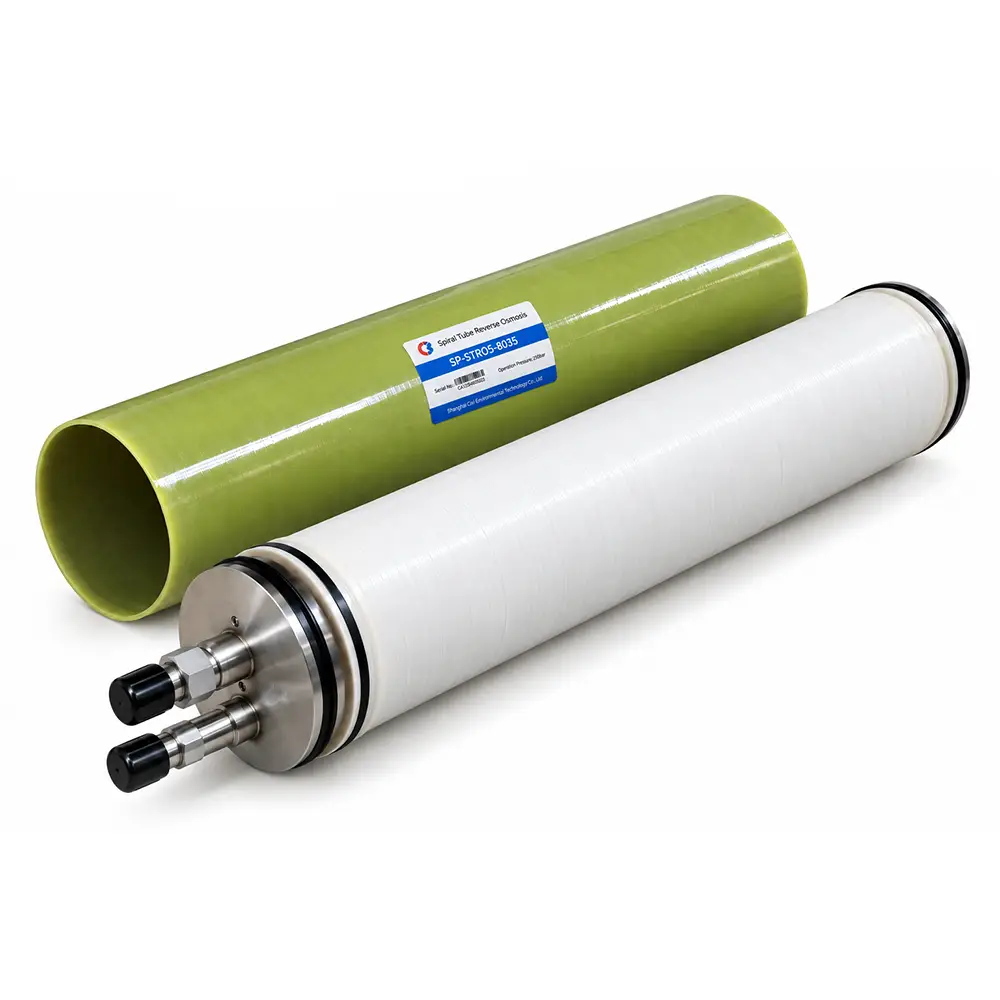
Is an STRO Membrane Right for Your Water?
A standard RO membrane is not always the best choice when feedwater becomes more concentrated, difficult to clean or prone to fouling.
An STRO membrane provides a more open feed channel and is designed for demanding wastewater concentration duties.
Not sure whether STRO fits your feedwater?
Send us your water analysis, treatment capacity and target recovery. We can review the operating conditions before recommending a membrane.
Check My Water QualityRO Concentrate
Further concentrate reject water from an existing RO system and reduce downstream treatment volume.
High-Salinity Wastewater
Treat industrial wastewater with elevated dissolved salts where higher operating pressure may be required.
Difficult Industrial Wastewater
Improve hydraulic conditions where fouling, scaling or concentration polarization limits conventional RO operation.
Pretreated Landfill Leachate
Use STRO as part of a membrane treatment or concentration process after suitable pretreatment.
ZLD Concentration Streams
Reduce wastewater volume before evaporation, crystallization or other downstream ZLD processes.
Wastewater Reuse Projects
Recover additional water from concentrated streams where technically and economically feasible.
STRO Membrane Element Specifications
Technical performance and dimensional data for STRO and STNF membrane elements designed for high-pressure and challenging water treatment applications.
Performance Specifications
| Parameter | STRO3-8035 | STRO5-8042 | STNF2-8042 |
|---|---|---|---|
| Membrane Type | RO3 | RO5 | NF2 |
| Effective Membrane Area | 25 m² | 27 m² | 27 m² |
| Feed Flow Range | 5.5–12 m³/h | 5.5–12 m³/h | 5.5–12 m³/h |
| Recommended Feed Flow | 10 m³/h | 10 m³/h | 10 m³/h |
| Permeate Flow* | 23 m³/day | 24 m³/day | 25 m³/day |
| Stabilized Salt Rejection* | 98.5% | 99.5% | 98% |
| Minimum Salt Rejection | 97.5% | 99% | 96% |
| Feed Spacer / Flow Channel | Special Open-Channel Design (Trapezoidal) | ||
| Maximum Pressure Drop | 1.0 bar | 1.0 bar | 1.0 bar |
| Maximum Operating Pressure | 90 bar | 90 bar | 90 bar |
| Maximum Operating Temperature | 45°C | 45°C | 45°C |
| Continuous Operating pH | 3–11 | 3–11 | 3–11 |
| Short-Term Cleaning pH | 2–12 | 2–12 | 2–12 |
| Free Chlorine Tolerance | ≤0.1 ppm | ≤0.1 ppm | ≤0.1 ppm |
Dimensions & Connections
Mechanical dimensions for 8035 and 8042 STRO membrane elements.
| Parameter | 8035 | 8042 |
|---|---|---|
| Overall Element Length A | 1140 mm | 1355 mm |
| Membrane Length B | 1000 mm | 1200 mm |
| Support Height D | 85 mm | 85 mm |
| Feed / Concentrate Connection | 1 in. Clamp Connection | 1 in. Clamp Connection |
| Permeate Connection |
2 × Hose Quick-Connect Ports 11.6 × 9 mm |
2 × Hose Quick-Connect Ports 11.6 × 9 mm |
| Pressure Rating | 75 / 90 bar | 75 / 90 bar |
| Element Diameter C | 216 / 220 mm | 216 / 220 mm |
Standard Test Conditions
Permeate flow and rejection values are based on the following laboratory conditions.
+
Standard Test Conditions
Permeate flow and rejection values are based on the following laboratory conditions.
- Test Solution
- 2,000 mg/L NaCl
- Pressure
- 15.5 bar
- Recovery
- 15%
- Temperature
- 25°C
- Test Solution
- 32,000 mg/L NaCl
- Pressure
- 55 bar
- Recovery
- 8%
- Temperature
- 25°C
- pH
- 8
- Test Solution
- 2,000 mg/L MgSO₄
- Pressure
- 7 bar
- Recovery
- 15%
- Temperature
- 25°C
* Single-element permeate flow may vary by approximately ±15%. Actual permeate production depends on feedwater quality and operating conditions.
Customization: ST membrane elements can be manufactured using different membrane sheets according to project requirements, including STRO4-8035, STRO5-8035, STRO1-8042 and STNF1-8042 .
Need a Different STRO Membrane Configuration?
Send us your feedwater analysis, operating pressure and required capacity. Our engineers can recommend the appropriate STRO membrane element for your project.
Why Choose an STRO Membrane for Difficult Wastewater?
Open Feed Channel
The trapezoidal open-channel feed spacer provides a more open hydraulic path for the concentrate stream, helping reduce flow resistance and supporting effective membrane-surface crossflow.
High-Pressure Operation
With a maximum operating pressure of 90 bar, the SP-STRO5-8042 is designed for concentration applications where feed salinity increases during operation.
High Salt Rejection
The RO5 membrane provides 99.5% stable salt rejection under specified test conditions, supporting demanding separation and concentration duties.
Easier Cleaning
The open-channel configuration improves hydraulic access to the membrane surface, helping make cleaning more effective than tightly packed conventional RO feed channels.
How the STRO Membrane Works
The Spacer Tube Reverse Osmosis membrane combines reverse osmosis separation with an open-channel hydraulic design. Feedwater flows across the membrane surface under pressure.
Water passing through the RO membrane becomes permeate, while dissolved salts and rejected contaminants remain in the concentrate stream.
Main separation barrier for dissolved salts.
Creates the feedwater flow path and supports crossflow.
Collects treated water passing through the membrane.
Supports membrane operation under elevated pressure.
Introduces pressurized feedwater into the module.
Separate rejected concentrate and treated permeate.
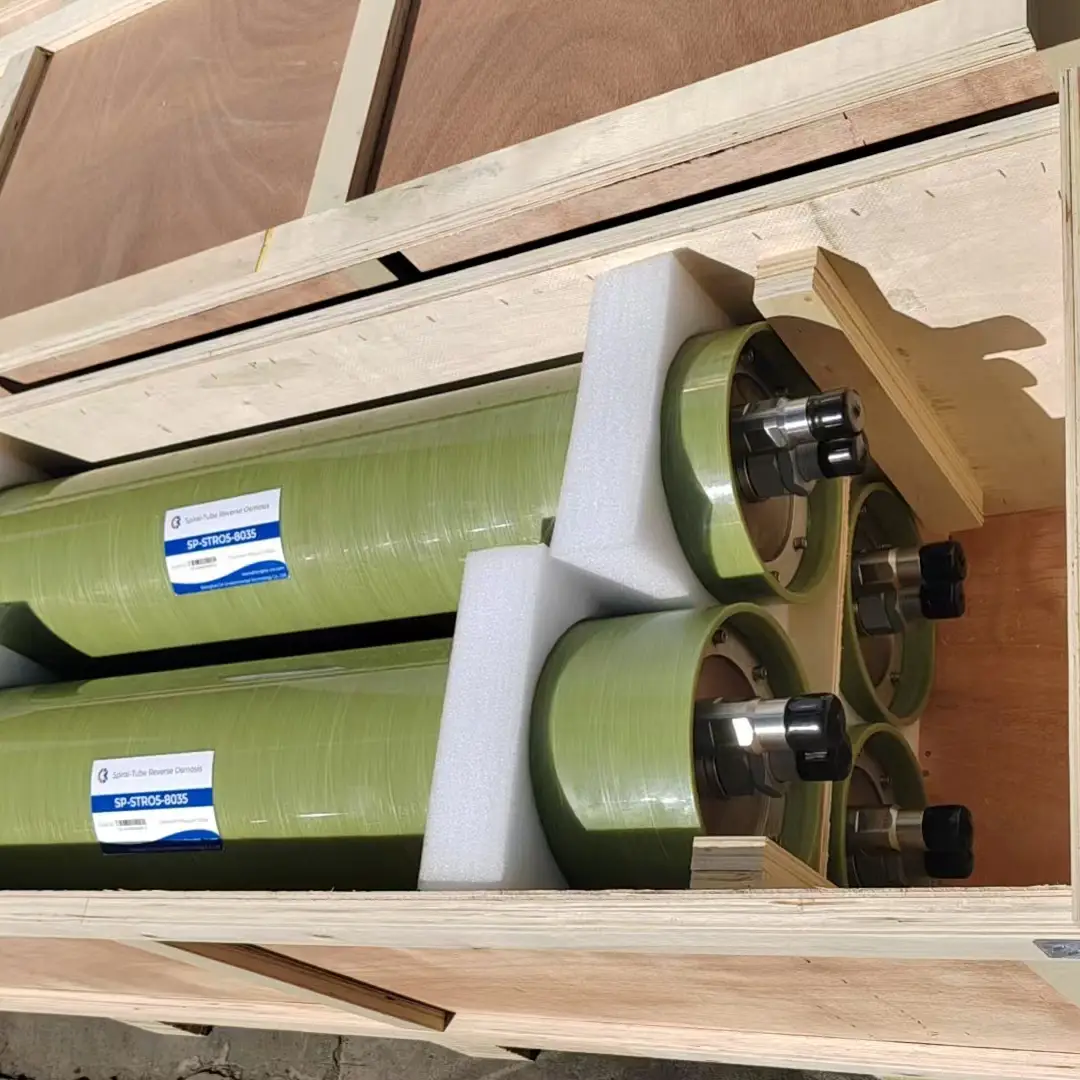
STRO vs DTRO vs Conventional RO
Selecting the right membrane technology depends on feedwater quality, pretreatment, concentration target, fouling potential and required recovery.
| Feature | Conventional RO | STRO | DTRO |
|---|---|---|---|
| Membrane Configuration | Spiral Wound | Open-Channel Spiral | Disc Tube |
| Feed Channel | Relatively Narrow | More Open | Very Open |
| Packing Density | High | High | Lower |
| Fouling Resistance | Standard | Higher | Very High |
| High-Pressure Concentration | Limited by Design | Suitable | Suitable |
| Cleaning Accessibility | Standard | Improved | High |
| Typical Feedwater | Well-Pretreated Water | Difficult / Concentrated Wastewater | Very Difficult Wastewater |
| RO Concentrate Treatment | Limited | Suitable | Suitable |
When Should You Consider STRO?
Consider STRO when you need higher-pressure RO concentration while maintaining a relatively compact membrane configuration.
- ●Existing RO concentrate requiring further concentration
- ●High-salinity industrial wastewater
- ●Wastewater with increased fouling or scaling potential
- ●ZLD pretreatment and volume reduction
When Should You Consider DTRO?
DTRO may be more suitable for extremely challenging and highly variable wastewater where an even more open flow path and stronger tolerance to difficult feed conditions are required.
There is no universal answer to STRO vs DTRO. The correct choice should be based on actual water chemistry and the complete treatment process.
STRO or DTRO? Ask Our Engineers →STRO Membrane Applications
RO Concentrate Treatment
Further concentrate reject water from an existing reverse osmosis system and recover additional permeate where feedwater conditions allow.
High-Salinity Industrial Wastewater
Suitable for industrial wastewater concentration where elevated TDS requires high-pressure membrane operation.
Landfill Leachate Treatment
STRO technology can be incorporated after appropriate upstream treatment and water-quality evaluation.
Chemical Wastewater
Support concentration and water recovery in selected chemical-industry wastewater applications with complex dissolved contaminants.
ZLD Pretreatment
Reduce wastewater volume entering evaporation or crystallization systems and potentially lower downstream hydraulic load.
Industrial Water Reuse
Recover additional water from concentrated wastewater streams as part of an engineered industrial reuse process.
Typical STRO Membrane Concentration Process
The exact process should be determined by feedwater chemistry, target recovery, permeate requirements and the final concentrate-disposal strategy.
Looking for a Replacement STRO Membrane?
Replacing an existing STRO membrane should not be based on membrane diameter alone. We review dimensional and operating requirements before recommending a CM replacement.
Already Have an Existing STRO Module?
Send us the following information for compatibility review:
- 1Existing model number
- 2Product nameplate photo
- 3Existing datasheet, if available
- 4Feedwater analysis
- 5Operating pressure and flow
More Than an STRO Membrane Supplier
CM supports engineering companies, system integrators and industrial users from membrane selection through project supply.
Water Analysis Review
Evaluate whether STRO is appropriate for the application using your feedwater data.
Membrane Selection
Select according to feed chemistry, operating pressure, treatment capacity and target recovery.
Replacement Evaluation
Review existing membrane dimensions and operating data before replacement selection.
System Design Support
Support membrane quantity, process configuration and associated water-treatment equipment.
Technical Documentation
Datasheets, dimensional information and project-evaluation documents are available.
B2B Project Supply
Support OEM, EPC, system-integrator and industrial water-treatment projects internationally.
Why Choose CM as Your STRO Membrane Manufacturer?
Years of Water Treatment Experience
Membrane products, industrial RO equipment and wastewater-treatment application experience.
Engineering-Oriented Selection
Recommendations based on actual feedwater conditions rather than capacity alone.
Stable Product Specifications
Defined membrane area, flow, rejection, operating limits and test conditions.
Membranes + Complete Systems
Industrial RO, UF, MBR and related membrane-treatment equipment support.
Project Documentation
Technical datasheets and dimensional information for engineering and procurement teams.
International Project Support
Support for overseas water-treatment companies, engineering contractors and industrial customers.
STRO Membrane Technical Resources
Need information for your engineering team?
SP-STRO5-8042 Technical Datasheet
- ✓ Membrane specifications
- ✓ Operating limits
- ✓ Test conditions
- ✓ Module dimensions
- ✓ Connection information
Datasheet Cover Placeholder
Replace with PDF cover image if desired
STRO Membrane FAQ
What is an STRO membrane? +
STRO stands for Spacer Tube Reverse Osmosis. An STRO membrane uses reverse osmosis separation together with a more open feed-channel configuration and is designed for demanding wastewater concentration applications.
What is an STRO membrane used for?+
Typical applications include high-salinity industrial wastewater, RO concentrate, selected landfill leachate streams, wastewater reuse and concentration before downstream ZLD treatment.
What is the maximum operating pressure of the CM STRO membrane?+
The CM SP-STRO5-8042 has a maximum operating pressure of 90 bar. Actual operating pressure should be determined according to feed salinity, temperature, recovery and overall system design.
What is the salt rejection of the SP-STRO5-8042?+
The membrane has a 99.5% stable salt rejection and 99% minimum salt rejection under the specified reference test conditions. Actual rejection may vary according to feedwater chemistry and operating conditions.
What is the difference between STRO and conventional RO?+
Conventional spiral-wound RO membranes typically use narrower feed channels and are usually applied to well-pretreated water. STRO uses a more open feed-channel configuration and is designed for more demanding concentration and wastewater applications.
What is the difference between STRO and DTRO?+
STRO uses an open-channel spiral membrane configuration, while DTRO uses a disc-tube membrane configuration. Both can be used for difficult wastewater, but the best choice depends on feedwater quality, fouling potential, pretreatment, operating pressure and project objectives.
Can an STRO membrane treat RO concentrate?+
Yes. RO concentrate is one of the common applications considered for STRO membrane concentration. Final design should be based on concentrate chemistry, scaling potential and the required final recovery.
Can STRO be used for landfill leachate?+
STRO can be used in selected landfill-leachate treatment processes, usually as part of a complete treatment train. Suitability depends on upstream treatment and the actual leachate composition.
How often should an STRO membrane be cleaned?+
There is no fixed cleaning interval for every system. Cleaning frequency depends on normalized permeate flow, differential pressure, salt passage, feedwater quality and system operation. Cleaning should be based on membrane-performance trends rather than a fixed calendar interval.
How long does an STRO membrane last?+
Service life depends on pretreatment, feedwater chemistry, operating pressure, cleaning practices, temperature, fouling and scaling control. A water analysis and operating history are useful when evaluating expected membrane performance.
How do I select the correct STRO membrane?+
Send us your feedwater analysis and project requirements, including:
Get Your STRO Membrane Recommendation
Not sure whether SP-STRO5-8042 is right for your wastewater? Send us your feedwater analysis, existing membrane information or project requirements.
Have an existing membrane system? Upload the model or datasheet and we will review it together with your project requirements.