
River water can be treated into drinking water, but it cannot be used directly. You need to remove turbidity, suspended solids, microorganisms, organic matter, dissolved salts, hardness, nitrate, fluoride, chloride, sulfate, and possible heavy metals. A reverse osmosis system plays a key role in reducing TDS, conductivity, dissolved ions, and chemical contaminants. To produce safe drinking water, RO must work together with pretreatment, disinfection, remineralization, and continuous water quality monitoring.
Why River Water Needs Complete Treatment Before Drinking ?
River water is a common raw water source for municipal drinking water plants, rural water supply projects, industrial parks, hotels, islands, camps, and emergency water supply systems. However, river water quality is usually unstable. It can change because of rainfall, seasonal flow, sediment, algae growth, agricultural runoff, upstream wastewater discharge, and industrial pollution.
Compared with groundwater, river water often contains higher turbidity, suspended solids, microorganisms, algae, organic matter, color, and odor. In some areas, river water may also contain high TDS, nitrate, fluoride, pesticides, ammonia nitrogen, heavy metals, or other dissolved contaminants.
This means you cannot treat river water with only one filter or one disinfection unit. You need a complete treatment process. Each step has a specific function. Some steps remove large debris. Some remove fine particles. Some remove colloids and organic matter. Some remove dissolved salts. Some kill or inactivate bacteria and viruses. Some adjust the final water taste, pH, and mineral balance.
In this process, the reverse osmosis system is one of the most important deep-treatment units. Conventional filtration can remove suspended solids and turbidity, but it cannot effectively remove most dissolved salts and ions. RO fills this gap. It helps reduce TDS, conductivity, hardness, chloride, sulfate, nitrate, fluoride, arsenic, sodium, and many other dissolved contaminants.
However, RO should not be used alone for river water. RO membranes need stable and clean feed water. If the feed water contains high turbidity, algae, iron, manganese, chlorine, suspended solids, colloids, oil, or microorganisms, the membrane can foul, scale, or become damaged. That is why river water drinking water systems usually need strong pretreatment before RO and proper post-treatment after RO.
Complete Process Flow: River Water to Drinking Water
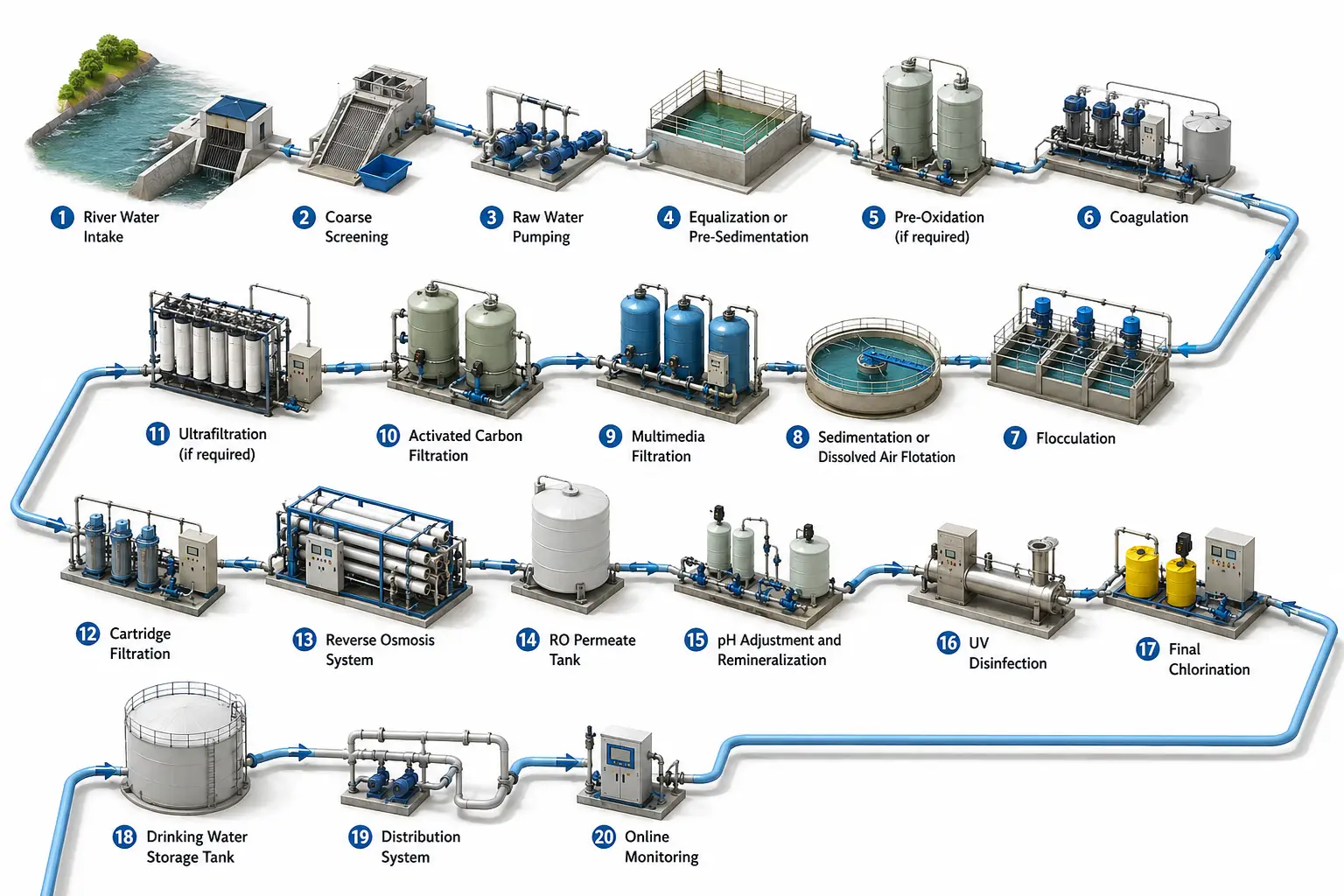
A typical river water drinking water treatment process may include:
River Water Intake
→ Coarse Screening
→ Raw Water Pumping
→ Equalization or Pre-Sedimentation
→ Pre-Oxidation, if required
→ Coagulation
→ Flocculation
→ Sedimentation or Dissolved Air Flotation
→ Multimedia Filtration
→ Activated Carbon Filtration
→ Ultrafiltration, if required
→ Cartridge Filtration
→ Reverse Osmosis System
→ RO Permeate Tank
→ pH Adjustment and Remineralization
→ UV Disinfection
→ Final Chlorination
→ Drinking Water Storage Tank
→ Distribution System
→ Online Monitoring
The actual process depends on raw water quality, treatment capacity, final drinking water standard, local regulations, available land, project budget, and whether the system is fixed, skid-mounted, or containerized.
For highly variable river water, a multi-barrier process is usually more reliable. The goal is not only to make the water clear. The goal is to make the water safe, stable, and suitable for drinking.
Step 1: River Water Intake
The first step is to take water from the river. The intake system should prevent large debris, sand, floating objects, aquatic plants, fish, and heavy sediment from entering the treatment plant.
A river water intake system may include:
- Intake structure
- Coarse screen
- Fine screen
- Intake pump
- Flow control valve
- Water level monitoring
- Sediment protection
- Emergency shut-off system
The intake location is very important. You should avoid areas close to wastewater discharge points, industrial outlets, agricultural runoff channels, stagnant water zones, and areas with heavy sediment accumulation. A better intake location can reduce the treatment burden and improve system stability.
Typical Raw River Water Parameters
Typical river water quality may vary widely, but common reference ranges include:
| Parameter | Typical Raw River Water Range |
|---|---|
| Turbidity | 10–500 NTU, sometimes higher after rainfall |
| TSS | 10–300 mg/L |
| pH | 6.5–8.5 |
| TDS | 100–2,000 mg/L |
| Conductivity | 200–3,000 μS/cm |
| Color | 10–200 Pt-Co |
| COD | 5–50 mg/L |
| TOC | 2–15 mg/L |
| Ammonia nitrogen | 0.1–5 mg/L |
| Iron | 0.1–5 mg/L |
| Manganese | 0.05–2 mg/L |
| Total coliform | Usually present |
| E. coli | May be present |
| Algae | Seasonal risk |
These are only engineering reference ranges. Final design must be based on laboratory testing of the actual river water.
Step 2: Coarse Screening and Fine Screening
Screening removes large physical impurities before the water enters the main treatment system. This protects pumps, pipes, valves, mixers, and downstream treatment equipment.
Coarse screens remove branches, leaves, plastic, stones, fish, and large floating objects. Fine screens remove smaller particles and reduce the load on the sedimentation and filtration stages.
Screening does not make water safe to drink. It only removes large debris. However, it is still an essential first protection step.
Main Control Parameters
| Parameter | Common Reference |
|---|---|
| Coarse screen opening | 5–20 mm |
| Fine screen opening | 1–5 mm |
| Head loss | Monitored continuously |
| Cleaning method | Manual or automatic |
| Flow rate | Based on plant capacity |
| Debris removal | Regular cleaning required |
If screens are not cleaned properly, they can block water flow and reduce plant capacity.
Step 3: Equalization or Pre-Sedimentation
River water quality changes quickly. After heavy rain, turbidity, sand, silt, and suspended solids may increase sharply. An equalization tank or pre-sedimentation basin helps reduce sudden water quality fluctuations before the main treatment process.
This step allows heavier particles to settle. It also gives operators more time to adjust chemical dosing when raw water quality changes.
Main Control Parameters
| Parameter | Common Reference |
|---|---|
| Hydraulic retention time | 1–6 hours |
| Turbidity reduction | Depends on raw water |
| Sludge removal | Regular discharge required |
| pH | Usually monitored |
| Flow balance | Required for stable operation |
| Sediment load | Higher in rainy seasons |
For high-turbidity rivers, this step can reduce the burden on coagulation, flocculation, sedimentation, filtration, UF, and RO.
Step 4: Pre-Oxidation, If Required
Pre-oxidation may be used when river water contains iron, manganese, color, odor, algae, ammonia, or certain organic contaminants. Common oxidants include sodium hypochlorite, chlorine dioxide, ozone, potassium permanganate, or other project-specific chemicals.
Pre-oxidation can convert some dissolved substances into particles that are easier to remove by filtration or sedimentation. For example, dissolved iron and manganese can be oxidized and then removed by filtration.
However, pre-oxidation must be carefully controlled. Too much oxidant may increase disinfection by-product risk or damage downstream membranes. If chlorine is used before RO, it must be removed before the water enters the RO membranes.
Main Control Parameters
| Parameter | Common Reference |
|---|---|
| ORP | Monitored according to oxidant type |
| Oxidant dosage | Based on jar test or pilot test |
| Contact time | Usually 10–30 minutes |
| Residual chlorine before RO | Nearly 0 mg/L |
| Iron removal target before RO | Usually <0.1 mg/L |
| Manganese removal target before RO | Usually <0.05 mg/L |
| DBP risk | Must be controlled |
Pre-oxidation is not required in every project. It should be selected according to water analysis and treatment goals.
Step 5: Coagulation
Coagulation is a key step in river water treatment. River water often contains fine particles, colloids, organic matter, algae, and color that cannot settle naturally.
A coagulant is added to destabilize these particles. Common coagulants include PAC, aluminum sulfate, ferric chloride, and other specialized chemicals. After coagulation, small particles can form larger flocs in the next step.
Main Control Parameters
| Parameter | Common Reference |
|---|---|
| Coagulant dosage | 5–80 mg/L, depending on raw water |
| pH | Controlled for best coagulation |
| Alkalinity | Important for pH stability |
| Rapid mixing time | Usually 30–120 seconds |
| Mixing intensity | High-speed mixing |
| Jar test | Recommended for dosage selection |
| Turbidity after coagulation | Monitored |
| TOC / color reduction | Monitored when required |
Good coagulation improves sedimentation, filtration, UF performance, and RO pretreatment stability. Poor coagulation can cause high turbidity and increase membrane fouling risk.
Step 6: Flocculation
After coagulation, the water enters the flocculation stage. Slow mixing helps destabilized particles collide and form larger flocs.
Flocculation is important because larger flocs can settle more easily or float more effectively in the next treatment step. If flocs are too small or weak, they may pass into downstream filters and increase fouling risk.
Main Control Parameters
| Parameter | Common Reference |
|---|---|
| Flocculation time | 15–30 minutes |
| Mixing speed | Low-speed mixing |
| Floc size | Visible and stable flocs preferred |
| Polymer dosage | Used if required |
| pH | Monitored |
| Temperature | Affects floc formation |
| Turbidity after flocculation | Monitored |
If mixing is too weak, flocs may not form well. If mixing is too strong, flocs may break apart.
Step 7: Sedimentation or Dissolved Air Flotation
After flocculation, water enters sedimentation or dissolved air flotation.
Sedimentation
Sedimentation uses gravity to remove heavier flocs. It is suitable when particles settle well.
Dissolved Air Flotation
Dissolved air flotation, or DAF, is often used when river water contains algae, low-density flocs, color, or organic matter. Tiny air bubbles attach to flocs and lift them to the water surface for removal.
Main Control Parameters
| Parameter | Common Reference |
|---|---|
| Surface loading rate | Based on design |
| Settled water turbidity | Usually targeted below 5 NTU, lower preferred |
| Sludge discharge | Regular removal required |
| Floc settling performance | Monitored |
| Flow distribution | Must be uniform |
| DAF recycle ratio | Controlled if DAF is used |
| Sludge blanket level | Monitored |
A well-operated sedimentation or DAF system greatly reduces turbidity before filtration.
Step 8: Multimedia Filtration
Multimedia filtration removes remaining suspended solids and turbidity after sedimentation or DAF. A typical multimedia filter may contain anthracite, quartz sand, and support gravel.
This step is very important before RO. RO membranes require clean and stable feed water. If suspended solids enter the RO system, they can block the membrane channels and increase pressure drop.
Main Control Parameters
| Parameter | Common Reference |
|---|---|
| Filter inlet turbidity | Depends on sedimentation performance |
| Filter outlet turbidity | Usually <1 NTU, lower preferred |
| Filtration rate | Based on design |
| Backwash frequency | Based on pressure drop and turbidity |
| Pressure drop | Monitored |
| SDI reduction | Important for RO protection |
| Backwash water quality | Should be suitable |
For RO pretreatment, lower turbidity is always better. If conventional filtration cannot provide stable quality, UF pretreatment may be needed.
Step 9: Activated Carbon Filtration
Activated carbon filtration removes residual chlorine, taste, odor, color, and some organic matter. It is especially important when chlorine or other oxidants are used before RO.
Many polyamide RO membranes are sensitive to free chlorine. If chlorine enters the RO system, it may damage the membrane and reduce salt rejection. Therefore, free chlorine should usually be reduced to nearly zero before RO.
Activated carbon also helps improve final water taste and reduce some organic compounds that may contribute to membrane fouling or disinfection by-product formation.
Main Control Parameters
| Parameter | Common Reference |
|---|---|
| Free chlorine after carbon filter | Nearly 0 mg/L before RO |
| TOC reduction | Monitored when required |
| Color and odor | Reduced |
| Empty bed contact time | Based on design |
| Pressure drop | Monitored |
| Backwash frequency | Regular backwash required |
| Carbon replacement | Based on performance |
| Microbial growth | Must be controlled |
Activated carbon filters need proper operation because they can become biological growth points if not maintained.
Step 10: Ultrafiltration, If Required
Ultrafiltration is often used as advanced pretreatment before RO, especially when river water quality is unstable. UF membranes can remove suspended solids, colloids, bacteria, algae, and many microorganisms.
For river water drinking water projects, UF + RO is a strong combination. UF protects RO by producing more stable feed water, while RO removes dissolved salts and ions.
Main Control Parameters
| Parameter | Common Reference |
|---|---|
| UF permeate turbidity | Often <0.1 NTU when well operated |
| SDI15 | Usually targeted <3 before RO |
| Transmembrane pressure | Monitored |
| Flux | Based on water quality |
| Backwash frequency | Automatic backwash |
| Chemical cleaning | Based on TMP increase |
| Integrity testing | Recommended for drinking water |
| Microbial control | Required |
UF is not always required, but for surface water and river water, it can greatly improve RO operation stability.
Step 11: Cartridge Filtration Before RO
A cartridge filter is installed before the high-pressure pump and RO membranes. It acts as the final safety filter before RO.
Common cartridge filter ratings are 1–5 microns. This filter removes fine particles that may pass through upstream units.
Main Control Parameters
| Parameter | Common Reference |
|---|---|
| Cartridge filter rating | 1–5 μm |
| Differential pressure | Monitored |
| Replacement frequency | Based on pressure drop |
| SDI15 before RO | Preferably <3 |
| Particle protection | Final safety barrier |
| Filter material | Selected according to feed water |
Cartridge filtration cannot replace good pretreatment. It is only the final protection step before RO.
Step 12: Reverse Osmosis System
The reverse osmosis system is the core desalination and deep purification step in river water drinking water treatment.
Upstream treatment removes debris, turbidity, suspended solids, color, odor, colloids, and microorganisms. RO focuses on dissolved contaminants. This is the main reason RO is important in drinking water projects.
What RO Can Reduce
A properly designed reverse osmosis system can help reduce:
- TDS
- Conductivity
- Hardness
- Calcium
- Magnesium
- Sodium
- Chloride
- Sulfate
- Nitrate
- Fluoride
- Arsenic
- Heavy metals
- Dissolved salts
- Some organic compounds
- Some micropollutants, depending on membrane type and system design
Conventional filtration cannot reliably remove most dissolved salts. Sand filtration cannot remove nitrate. Activated carbon cannot remove most inorganic salts. Disinfection cannot remove heavy metals. RO provides a membrane separation barrier for many dissolved substances.
Main RO Feed Water Parameters
Before water enters the RO system, you should control these indicators:
| Parameter | Recommended RO Feed Water Target |
|---|---|
| Turbidity | Preferably <0.1–0.5 NTU |
| SDI15 | Preferably <3 |
| Free chlorine | Nearly 0 mg/L |
| Iron | Usually <0.1 mg/L |
| Manganese | Usually <0.05 mg/L |
| Oil and grease | Not detectable |
| pH | Usually 6–8 for standard RO operation |
| Temperature | Commonly 5–35°C |
| Hardness | Controlled by softening or antiscalant |
| Microbial growth | Controlled by pretreatment and cleaning |
Main RO Operating Parameters
| Parameter | Purpose |
|---|---|
| Feed pressure | Indicates required membrane driving force |
| Permeate flow | Shows clean water production |
| Concentrate flow | Controls reject discharge |
| Recovery rate | Balances water use and scaling risk |
| Salt rejection | Shows membrane removal performance |
| Permeate conductivity | Indicates final RO water quality |
| Differential pressure | Indicates fouling or blockage risk |
| Membrane flux | Affects fouling rate |
| Antiscalant dosage | Controls scaling risk |
| Cleaning frequency | Indicates long-term operating condition |
For river water drinking water systems, RO recovery may commonly range from 50% to 80%, depending on feed water quality, scaling risk, system design, and concentrate discharge conditions. Higher recovery is not always better. If recovery is too high, scaling risk increases and membrane life may decrease.
Why RO Is the Key Step
RO is the step that deals with dissolved ions and many chemical contaminants. Without RO, the system may still produce clear water, but it may not reduce TDS, nitrate, fluoride, chloride, sulfate, hardness, sodium, or heavy metals enough for the required drinking water target.
However, RO should be protected by good pretreatment and supported by proper post-treatment. This is the correct way to use RO in a river water drinking water system.
Step 13: RO Permeate Tank
After RO treatment, permeate water enters a clean water tank before post-treatment. The tank must prevent secondary contamination.
Main Control Parameters
| Parameter | Requirement |
|---|---|
| Tank material | Suitable for drinking water |
| Tank design | Closed and clean |
| Vent filter | Recommended |
| Level control | Required |
| Cleaning schedule | Regular cleaning |
| Microbial control | Required |
| Water turnover | Avoid long stagnation |
Poor tank design can reintroduce bacteria into treated water.
Step 14: pH Adjustment and Remineralization
RO permeate is usually low in minerals, hardness, alkalinity, and TDS. Very low-mineral water may taste flat and may be corrosive to pipes and tanks. Therefore, drinking water RO systems often require remineralization and pH adjustment.
Common methods include:
- Calcite filter
- Limestone contactor
- Soda ash dosing
- Caustic soda dosing
- Calcium and magnesium dosing
- Alkalinity adjustment
- pH adjustment
Typical Final Water Targets
| Parameter | Common Target Range |
|---|---|
| pH | 6.5–8.5 |
| TDS | Often 50–500 mg/L, depending on local standard and taste |
| Hardness | Adjusted for taste and corrosion control |
| Alkalinity | Adjusted for stability |
| Conductivity | Based on local standard |
| Corrosion tendency | Controlled through pH and alkalinity |
The goal is not to produce ultra-pure water. The goal is to produce safe, stable, and drinkable water.
Step 15: UV Disinfection
UV disinfection can inactivate bacteria, viruses, and other microorganisms without adding chemicals. It is often used after RO and before final storage or distribution.
UV works best when water is clear. Since RO permeate is usually low in turbidity, UV can be effective as a post-treatment microbial barrier.
Main Control Parameters
| Parameter | Requirement |
|---|---|
| UV dose | Based on design |
| UV intensity | Monitored |
| UV transmittance | Must be suitable |
| Flow rate | Matched with UV system |
| Lamp aging | Regular replacement |
| Quartz sleeve | Regular cleaning |
| Microbial testing | Required |
UV does not provide residual protection in the distribution network. Therefore, many drinking water systems also use final chlorination.
Step 16: Final Chlorination or Final Disinfection
Final disinfection protects treated drinking water during storage and distribution. Chlorine is commonly used because it provides residual protection after treatment.
Main Control Parameters
| Parameter | Common Control Point |
|---|---|
| Free chlorine residual | Often 0.2–0.5 mg/L in distribution, depending on local regulations |
| Contact time | Must be sufficient |
| pH | Affects chlorine performance |
| Turbidity | Should be low |
| Temperature | Affects disinfection |
| DBP control | Required |
| E. coli | Should not be detected |
| Total coliform | Follow local regulation |
For effective disinfection, turbidity and organic matter should be controlled before chlorination. High turbidity can protect microorganisms, and high organic matter can increase chlorine demand and by-product risk.
Step 17: Drinking Water Storage and Distribution
After final disinfection, the treated water enters a drinking water storage tank and then the distribution network.
Even if the treatment plant produces good water, poor storage or distribution can cause recontamination. The storage tank and pipe network must be protected.
Main Control Parameters
| Parameter | Monitoring Requirement |
|---|---|
| Free chlorine residual | Monitored |
| E. coli | Routine testing |
| Total coliform | Routine testing |
| Turbidity | Monitored |
| pH | Monitored |
| Tank cleanliness | Regular cleaning |
| Water age | Controlled |
| Pipe pressure | Maintained |
| Leakage | Prevented |
| Biofilm | Controlled |
A drinking water treatment plant is not complete without monitoring and management after treatment.
Key Water Quality Parameters for River Water Drinking Water Treatment
The following table summarizes common parameters in river water to drinking water treatment projects. These are engineering reference values. Final limits must follow local drinking water regulations.
| Parameter | Raw Water Concern | Target Before RO | Final Drinking Water Target |
|---|---|---|---|
| Turbidity | Sediment, algae, colloids | <0.1–0.5 NTU preferred | <1 NTU, lower preferred |
| TSS | Suspended solids | Very low | Very low |
| SDI15 | RO fouling risk | <3 preferred | Not final-water parameter |
| pH | Treatment efficiency, corrosion | 6–8 for RO feed | 6.5–8.5 commonly used |
| TDS | Salinity and taste | Reduced by RO | Often <500 mg/L, based on local standard |
| Conductivity | Dissolved ion level | Reduced by RO | Based on local standard |
| Hardness | Scaling risk | Controlled before RO | Adjusted for taste and stability |
| Chloride | Salinity and corrosion | Reduced by RO | Based on local standard |
| Sulfate | Taste and scaling | Reduced by RO | Based on local standard |
| Nitrate | Health concern | Reduced by RO | Commonly ≤10 mg/L as nitrogen in many standards |
| Fluoride | Health concern at high level | Reduced by RO | Based on local standard |
| Arsenic | Toxic contaminant | Reduced by RO or adsorption | Very low limit required |
| Lead | Health concern | Reduced by RO and corrosion control | Very low limit required |
| Iron | Staining and fouling | <0.1 mg/L preferred before RO | Low, based on standard |
| Manganese | Staining and fouling | <0.05 mg/L preferred before RO | Low, based on standard |
| TOC | DBP precursor and fouling | As low as practical | Controlled |
| Ammonia nitrogen | Chlorine demand | Controlled | Based on local standard |
| E. coli | Fecal contamination | Removed or inactivated | Not detectable |
| Free chlorine | RO membrane damage risk | Nearly 0 before RO | Residual required after final disinfection |
The Main Role of RO in River Water Drinking Water Treatment
The reverse osmosis system is the key deep purification unit in this process. Its main role is different from conventional filtration.
Multimedia filters remove suspended solids. Activated carbon removes chlorine, taste, odor, and some organics. UF removes fine particles, colloids, and microorganisms. But RO removes many dissolved ions and chemical contaminants.
1. RO Reduces TDS and Conductivity
If river water has high dissolved salts, conventional filters cannot solve the problem. RO can significantly reduce TDS and conductivity, helping the water meet drinking water quality requirements.
2. RO Reduces Hardness and Scaling Ions
RO reduces calcium and magnesium, which are the main hardness ions. This helps reduce scaling risk in tanks, pipes, heaters, and distribution systems.
3. RO Reduces Nitrate, Fluoride, Chloride, and Sulfate
In some river water sources, nitrate, fluoride, chloride, and sulfate may be high. RO can help reduce these dissolved ions and improve final water safety and taste.
4. RO Helps Reduce Heavy Metals
Depending on water chemistry and membrane selection, RO can help reduce heavy metals such as arsenic, lead, chromium, copper, and other dissolved metals. In some cases, adsorption, oxidation, or special pretreatment may also be required.
5. RO Improves Water Quality Stability
River water quality changes with season and rainfall. With proper pretreatment, RO can produce more stable permeate water quality. This is useful for municipal plants, containerized drinking water systems, rural drinking water projects, islands, camps, hotels, and industrial parks.
Important Design Points for RO Drinking Water Systems
Pretreatment Must Be Strong Enough
RO cannot handle raw river water directly. The feed water must be pretreated. For river water, pretreatment may include coagulation, sedimentation, multimedia filtration, activated carbon, UF, and cartridge filtration.
Chlorine Must Be Removed Before RO
If chlorine is used before RO, it must be removed before the water reaches the RO membrane. Activated carbon filtration or chemical dechlorination is commonly used.
Recovery Rate Must Be Carefully Designed
Higher recovery reduces water waste, but it increases scaling risk. Recovery should be designed based on TDS, hardness, silica, alkalinity, temperature, antiscalant dosing, and concentrate disposal conditions.
Concentrate Disposal Must Be Planned
RO produces clean permeate and concentrated reject water. The concentrate contains rejected salts and contaminants. You must plan its discharge, reuse, evaporation, or further treatment according to local environmental requirements.
Post-Treatment Is Necessary
RO permeate may require remineralization, pH adjustment, UV disinfection, and final chlorination. Drinking water should be safe, stable, and acceptable in taste.
Continuous Monitoring Is Required
Drinking water systems require continuous monitoring. Online instruments and regular lab tests help ensure stable water quality and safe operation.
Typical Online Monitoring Instruments
A river water drinking water treatment plant may use:
- Raw water turbidity meter
- pH meter
- Conductivity meter
- ORP meter
- Flow meter
- Pressure gauge
- SDI testing point
- Free chlorine analyzer
- RO permeate conductivity meter
- RO feed pressure transmitter
- RO differential pressure monitoring
- UV intensity monitor
- Final water chlorine analyzer
- Final water turbidity meter
- Water tank level transmitter
These instruments help operators detect problems early. For example, rising RO differential pressure may indicate fouling. Increasing permeate conductivity may indicate membrane damage, scaling, or poor salt rejection. Low chlorine residual may indicate distribution system risk.
Common Applications of River Water RO Drinking Water Systems
River water to drinking water RO systems can be used in:
- Municipal drinking water plants
- Rural drinking water projects
- Emergency drinking water supply
- Island water supply
- Containerized drinking water plants
- Remote camps
- Mining camps
- Construction camps
- Industrial parks
- Hotels and resorts
- Schools and hospitals
- Military or temporary water supply projects
For remote and overseas projects, containerized river water RO drinking water systems are often useful because they are easier to transport, install, and operate.
What Information Should You Provide Before Requesting a Proposal?
To design a suitable river water drinking water treatment system, you should provide:
- Raw water source
- Full water analysis report
- Seasonal water quality variation
- Required capacity
- Daily operating hours
- Target drinking water standard
- Required recovery rate
- Available installation space
- Power supply
- Local concentrate discharge requirements
- Whether containerized design is required
- Whether UF pretreatment is required
- Final disinfection requirement
- Storage and distribution conditions
- Project location
If you do not have a complete water analysis report, you should test the river water before final design. At minimum, the test should include turbidity, TSS, pH, TDS, conductivity, hardness, alkalinity, chloride, sulfate, nitrate, fluoride, iron, manganese, arsenic, ammonia nitrogen, TOC or COD, total coliform, and E. coli.
FAQ About River Water to Drinking Water RO Systems
1. Can river water be treated into drinking water?
Yes. River water can be treated into drinking water, but it needs a complete treatment process. The system usually includes screening, coagulation, flocculation, sedimentation, filtration, activated carbon, UF if required, RO, remineralization, UV disinfection, final chlorination, and continuous monitoring. The final water must meet local drinking water standards.
2. Why is reverse osmosis important in river water drinking water treatment?
Reverse osmosis is important because it removes many dissolved contaminants that conventional filtration cannot remove effectively. RO can reduce TDS, conductivity, hardness, nitrate, fluoride, chloride, sulfate, sodium, arsenic, and many heavy metals. It is the key deep-treatment step when river water contains high dissolved salts or chemical contaminants.
3. Can RO remove bacteria and viruses from river water?
RO membranes can provide a strong barrier, but RO should not be used as the only microbial control step. In river water drinking water systems, microorganisms are usually controlled through multiple barriers, such as coagulation, sedimentation, filtration, UF, UV disinfection, and final chlorination. Final disinfection is still needed to protect water during storage and distribution.
4. Is pretreatment necessary before RO?
Yes. Pretreatment is necessary before RO, especially for river water. Raw river water may contain turbidity, suspended solids, algae, colloids, organic matter, iron, manganese, and microorganisms. Without pretreatment, RO membranes can foul, scale, or become damaged. Common pretreatment includes coagulation, sedimentation, multimedia filtration, activated carbon, UF, and cartridge filtration.
5. What water quality should be controlled before the RO system?
Before RO, you should control turbidity, SDI, free chlorine, iron, manganese, oil, hardness, scaling risk, pH, temperature, and microbial growth. As an engineering reference, RO feed water is often designed with turbidity below 0.1–0.5 NTU, SDI15 below 3, and free chlorine nearly 0 mg/L for chlorine-sensitive RO membranes.
6. Why does RO permeate need remineralization?
RO removes many dissolved minerals from water. This can make the water low in TDS, alkalinity, calcium, and magnesium. Very low-mineral water may taste flat and may become corrosive to pipes or tanks. Remineralization and pH adjustment help improve taste, stability, and corrosion control before the water enters storage and distribution.
7. What happens to the RO concentrate?
RO produces permeate and concentrate. Permeate becomes treated water, while concentrate contains the rejected salts and contaminants. The concentrate must be properly discharged, reused, evaporated, or further treated according to local environmental regulations. Concentrate management should be considered during system design.
8. Can a river water RO drinking water system be containerized?
Yes. River water RO drinking water systems can be designed as containerized systems. A containerized system can include pretreatment, UF, RO, chemical dosing, remineralization, disinfection, control system, and pipework inside one or more containers. This design is useful for remote areas, islands, camps, emergency water supply, industrial parks, and overseas projects.
Conclusion
Turning river water into drinking water requires a complete treatment system, not one single machine. Each step has its function. Screening removes large debris. Coagulation and flocculation remove colloids and fine particles. Sedimentation or DAF removes flocs. Multimedia filtration reduces turbidity. Activated carbon removes chlorine, odor, color, and some organics. UF protects RO and removes fine particles and microorganisms. RO removes dissolved salts, TDS, hardness, nitrate, fluoride, chloride, sulfate, sodium, arsenic, and many other dissolved contaminants. Remineralization adjusts taste and water stability. UV and final chlorination protect microbial safety.
The reverse osmosis system is the core deep-treatment unit in this process. It solves many problems that conventional filtration cannot solve, especially dissolved ions and chemical contaminants. However, RO must be protected by proper pretreatment and supported by correct post-treatment.
If you are planning a river water drinking water treatment project, send us your raw water analysis report, required capacity, target drinking water standard, and project location. CM can help you design a complete river water treatment system with pretreatment, UF, RO, remineralization, disinfection, and containerized or skid-mounted equipment options.