
A reliable sewage treatment process is not only about removing pollutants. It is also about stable operation, compact design, easy maintenance, and consistent effluent quality. For many municipal, domestic, and industrial wastewater projects, the AO + MBR process has become a practical solution because it combines biological treatment with membrane separation.
Based on the process flow diagram of a sewage treatment station, this system adopts the process of Primary Sedimentation Tank + AO + MBR, with wastewater passing through bar screening, primary sedimentation or regulating tank, AO + MBR treatment, disinfection, and final standard-compliant effluent discharge.
For project owners, EPC contractors, and water treatment engineering companies, understanding each part of the process helps you choose the right MBR membrane system, reduce operating risks, and design a sewage treatment plant that can meet discharge or reuse requirements.
What Is an MBR Sewage Treatment System?
An MBR sewage treatment system is a wastewater treatment solution that combines biological treatment and membrane filtration. MBR stands for Membrane Bioreactor. In a conventional activated sludge process, the final separation of sludge and treated water usually depends on a secondary sedimentation tank. In an MBR system, this separation is completed by the MBR membrane module.
This means the system can retain suspended solids, bacteria, and activated sludge inside the biological treatment tank, while clean water passes through the membrane pores and is collected as treated effluent.
For many projects, this brings several important advantages:
The system footprint is smaller than traditional wastewater treatment processes.
The effluent quality is more stable because membrane separation is not easily affected by sludge settling performance.
The treated water can be suitable for discharge or further reuse after disinfection.
The equipment can be designed as integrated MBR equipment or a packaged sewage treatment plant, which is useful for decentralized wastewater treatment projects.
That is why MBR wastewater treatment is widely used in residential communities, hotels, schools, hospitals, factories, industrial parks, rural sewage treatment, municipal sewage treatment, and wastewater reuse projects.
Complete Sewage Treatment Process Flow
A typical AO + MBR wastewater treatment process includes the following steps:
Influent Wastewater → Bar Screen → Primary Sedimentation / Regulating Tank → Collection Tank → Lift Pump → Anaerobic Tank → Aerobic Tank → Membrane Tank → Clean Water Tank → UV Disinfection → Effluent Discharge
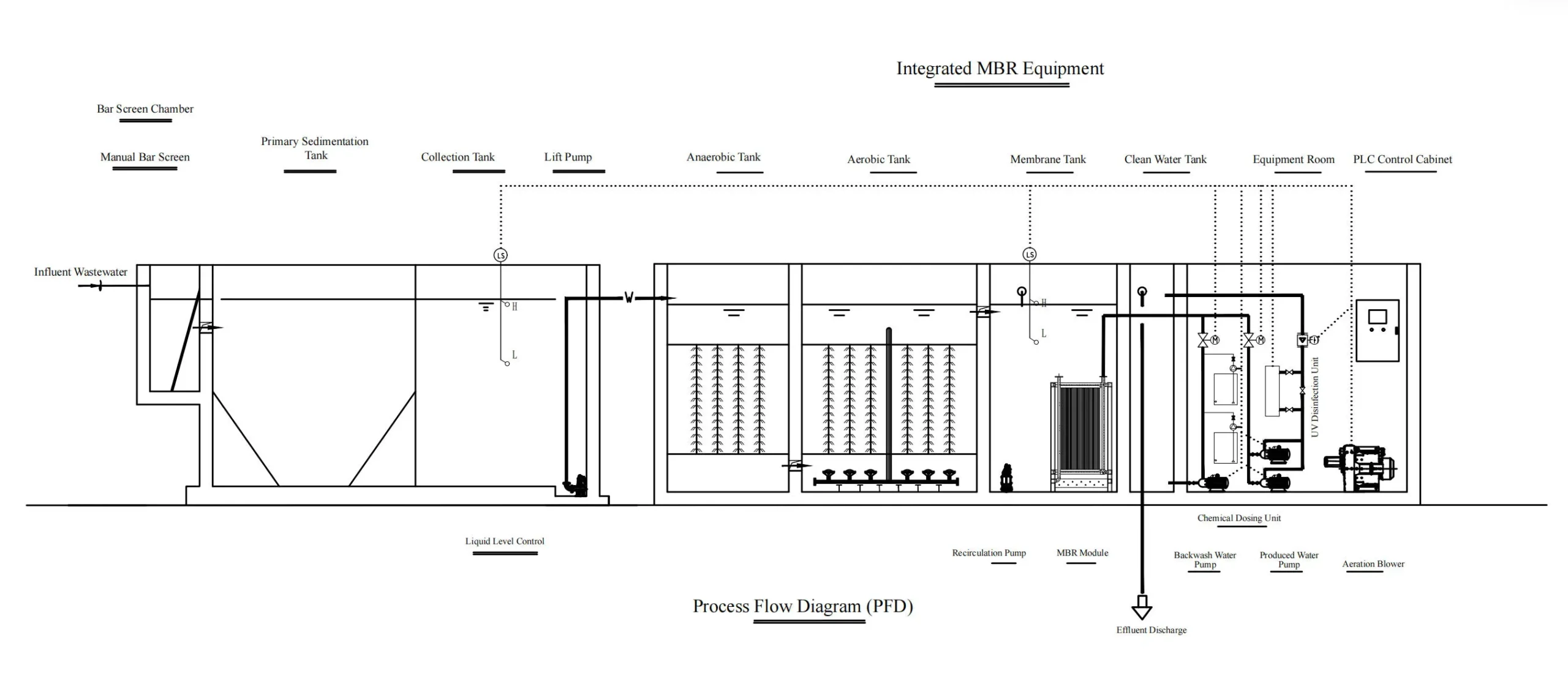
At the same time, the system includes supporting equipment such as aeration blowers, recirculation pumps, produced water pumps, backwash water pumps, chemical dosing units, PLC control cabinet, and liquid level control.
Each stage plays a specific role in the complete sewage treatment process.---
Typical Wastewater Treatment Parameters in an AO + MBR Process
In a sewage treatment plant, process design should not only focus on equipment selection. Key wastewater treatment parameters such as COD, BOD, suspended solids, ammonia nitrogen, total nitrogen, total phosphorus, pH, and turbidity should also be carefully checked.
For an AO + MBR sewage treatment process, wastewater usually passes through bar screening, primary sedimentation or regulating tank, anaerobic tank, aerobic tank, membrane tank, clean water tank, and UV disinfection before final effluent discharge. The process flow diagram shows that this sewage treatment station adopts Primary Sedimentation Tank + AO + MBR as the main treatment process, followed by disinfection and standard-compliant effluent discharge.
The following table shows common wastewater quality parameters and their typical changes during the MBR wastewater treatment process.
Wastewater Treatment Parameters Table
| Treatment Stage | Main Function | Key Parameters to Monitor | Typical Reference Range / Target | Why It Matters |
|---|---|---|---|---|
| Influent Wastewater | Raw sewage enters the treatment system | COD, BOD₅, SS, NH₃-N, TN, TP, pH, oil & grease | Depends on wastewater source | Determines the process design, MBR membrane quantity, aeration demand, and tank volume |
| Bar Screen Chamber | Removes large solids and floating debris | Large particles, fibers, plastics, rags | Manual or mechanical removal | Protects pumps, pipes, and MBR membrane modules from blockage |
| Primary Sedimentation / Regulating Tank | Removes settleable solids and balances flow | SS, flow rate, pH, COD fluctuation | More stable flow and pollutant load | Reduces shock load to the biological treatment system |
| Anaerobic Tank | Supports biological phosphorus removal and prepares wastewater for further treatment | DO, ORP, TP, COD | Low dissolved oxygen condition | Helps improve nutrient removal in the AO MBR process |
| Aerobic Tank | Biological degradation of organic pollutants and ammonia nitrogen | DO, MLSS, COD, BOD₅, NH₃-N, sludge activity | DO usually controlled at suitable aerobic level | Removes organic pollutants and supports nitrification |
| Membrane Tank | Solid-liquid separation by MBR membrane | MLSS, TMP, membrane flux, SS, turbidity | Low SS and turbidity in produced water | The MBR membrane retains activated sludge and suspended solids |
| Clean Water Tank | Stores treated water after membrane filtration | Turbidity, COD, BOD₅, SS | Stable treated water quality | Provides water for discharge, reuse, or backwash |
| UV Disinfection Unit | Final disinfection before discharge or reuse | E. coli, bacteria, UV intensity | Based on local discharge or reuse standard | Improves microbiological safety of final effluent |
| Final Effluent Discharge | Treated water leaves the system | COD, BOD₅, SS, NH₃-N, TN, TP, pH, turbidity | Must meet local effluent discharge standard | Confirms whether the sewage treatment system meets project requirements |
Typical Influent and MBR Effluent Quality Reference
Note: The values below are general reference ranges for domestic sewage and municipal-type wastewater. Actual design should be based on raw water analysis, local discharge standards, and project requirements.
| Water Quality Parameter | Typical Influent Range | Typical MBR Effluent Target | Treatment Meaning |
|---|---|---|---|
| COD | 150–500 mg/L | ≤30–50 mg/L | Indicates organic pollution removal performance |
| BOD₅ | 80–250 mg/L | ≤5–10 mg/L | Shows biodegradable organic matter removal |
| Suspended Solids, SS | 100–300 mg/L | ≤5 mg/L | MBR membrane provides stable solid-liquid separation |
| Ammonia Nitrogen, NH₃-N | 20–50 mg/L | ≤5–8 mg/L | Depends on aerobic nitrification performance |
| Total Nitrogen, TN | 30–70 mg/L | ≤15–20 mg/L | Depends on AO process and internal recirculation |
| Total Phosphorus, TP | 3–8 mg/L | ≤0.5–1.0 mg/L | May require biological and/or chemical phosphorus removal |
| pH | 6–9 | 6–9 | Affects biological activity and membrane operation |
| Turbidity | High / variable | ≤1 NTU | Important for reuse and stable effluent quality |
How These Parameters Affect MBR Membrane Selection
When designing an MBR wastewater treatment system, these wastewater treatment indicators directly affect the selection of the MBR membrane module.
If the influent COD and BOD are high, the biological tank volume and aeration capacity should be increased. If suspended solids, fibers, or oil content are high, pretreatment should be strengthened to protect the membrane surface. If ammonia nitrogen and total nitrogen limits are strict, the AO process, internal recirculation, sludge concentration, and dissolved oxygen control must be designed carefully.
For the membrane tank, the most important operating parameters include:
| MBR Operation Parameter | Typical Design Focus | Impact on System Performance |
|---|---|---|
| Membrane Flux | Should be selected conservatively according to wastewater quality | Too high flux may increase membrane fouling risk |
| TMP, Transmembrane Pressure | Used to monitor membrane fouling | Rising TMP means the membrane may need cleaning |
| MLSS | Activated sludge concentration in biological system | Affects biological treatment efficiency and membrane operation |
| Aeration Intensity | Provides oxygen and membrane scouring | Affects energy cost and anti-fouling performance |
| Backwash Frequency | Regular physical cleaning | Helps maintain stable water production |
| Chemical Cleaning | Periodic recovery cleaning | Extends membrane service life |
A good MBR membrane system should not only meet the required effluent standard. It should also maintain stable flux, lower fouling risk, and reduce long-term operation cost.
1. Influent Wastewater Collection
The process starts with influent wastewater entering the sewage treatment station. The influent may come from domestic sewage, municipal wastewater, industrial park wastewater, factory wastewater, or mixed wastewater from commercial facilities.
Before selecting an MBR membrane system, the wastewater source should be clearly analyzed. Different wastewater sources may have different COD, BOD, ammonia nitrogen, suspended solids, oil content, pH, and salinity.
For example, domestic sewage is usually easier to treat than high-strength industrial wastewater. Industrial wastewater may require additional pretreatment before entering the biological treatment system. If the feed water contains excessive oil, fiber, sand, large particles, toxic chemicals, or high organic load, the pretreatment process must be designed carefully to protect the MBR membrane module and biological system.
2. Bar Screen Chamber and Manual Bar Screen
The first treatment step is usually the bar screen chamber. The manual bar screen removes large solids such as plastic pieces, fibers, leaves, packaging materials, and other floating debris.
This step may look simple, but it is very important for the whole wastewater treatment process. If large solids enter the downstream tanks, they may block pumps, damage equipment, clog pipelines, or increase the cleaning frequency of the MBR membrane.
For small and medium sewage treatment stations, a manual bar screen can be a cost-effective option. For larger plants or higher-flow projects, an automatic mechanical screen may be recommended.
The purpose is the same: protect the downstream treatment units and keep the sewage treatment system running smoothly.
3. Primary Sedimentation Tank or Regulating Tank
After screening, wastewater enters the primary sedimentation tank or regulating tank. This stage helps remove heavier suspended solids and balance influent water quality.
In actual sewage treatment projects, the influent flow and pollutant concentration are often not stable. For example, hotels, schools, factories, and residential communities may have peak wastewater flow during certain hours. A regulating tank helps equalize flow and reduce shock loads to the AO + MBR system.
This is important because biological treatment systems need relatively stable conditions. Sudden changes in flow rate, COD, ammonia nitrogen, or pH may affect microbial activity and reduce treatment efficiency.
A well-designed regulating tank improves the stability of the entire MBR wastewater treatment system.
4. Collection Tank and Lift Pump
After primary treatment, wastewater enters the collection tank. From here, the lift pump transfers wastewater into the biological treatment section.
The lift pump should be selected according to the design flow rate, head requirement, operating hours, and system automation level. In integrated MBR equipment, the lift pump is often connected with liquid level control. When the water level reaches a set point, the pump starts automatically. When the water level drops, the pump stops.
This helps protect the pump from dry running and supports stable automatic operation.
For small packaged sewage treatment plants, automatic liquid level control is especially important because many systems are installed in remote locations, rural areas, resorts, or industrial sites where operators may not monitor the system all day.
5. Anaerobic Tank in the AO Process
The AO process usually includes an anaerobic tank and an aerobic tank. In the anaerobic tank, wastewater is treated under low-oxygen or oxygen-free conditions. This stage helps improve biological phosphorus removal and prepares wastewater for further aerobic treatment.
For some sewage treatment projects, internal recirculation may also be used to improve nitrogen removal performance. The recirculation pump can return mixed liquor from the aerobic or membrane section back to the previous tank, helping create better conditions for denitrification.
The design of the anaerobic tank depends on influent quality, discharge standard, hydraulic retention time, sludge concentration, and treatment target.
When you are choosing an AO MBR process, it is important not only to focus on the membrane tank. The biological treatment section determines how effectively organic pollutants, nitrogen, and phosphorus can be removed before membrane filtration.
6. Aerobic Tank for Biological Degradation
The aerobic tank is one of the most important parts of the sewage treatment process. In this tank, microorganisms break down organic pollutants under aerated conditions.
The aeration blower supplies oxygen to support microbial activity. Proper aeration helps remove BOD, COD, and ammonia nitrogen. It also keeps activated sludge in suspension and creates suitable conditions for nitrification.
However, aeration design must be balanced. Too little aeration may reduce treatment efficiency. Too much aeration may waste energy and increase operating cost. In an MBR sewage treatment plant, aeration is also closely related to membrane operation, because membrane scouring air helps reduce membrane fouling.
For this reason, the blower system should be selected according to both biological oxygen demand and membrane cleaning requirements.
7. Membrane Tank and MBR Module
After biological treatment, wastewater enters the membrane tank, where the MBR membrane module performs solid-liquid separation.
This is the key difference between an MBR membrane system and a traditional activated sludge process. Instead of relying on gravity settling in a secondary clarifier, the MBR membrane retains suspended solids, activated sludge, and microorganisms inside the system. Treated water passes through the membrane and is pumped out as clean water.
The membrane tank can use hollow fiber MBR membranes or flat sheet MBR membranes, depending on project requirements.
A high-quality MBR membrane should have good permeability, strong anti-fouling performance, stable mechanical strength, and reliable long-term operation. For sewage treatment projects, membrane selection directly affects effluent quality, energy consumption, cleaning frequency, and maintenance cost.
This is why many EPC contractors and wastewater treatment companies pay close attention to the following points when selecting MBR membranes:
Membrane material and pore size.
Flux design and operating pressure.
Anti-fouling performance.
Chemical cleaning resistance.
Module structure and installation method.
Expected service life.
Compatibility with existing MBR equipment.
For replacement projects, it is also important to check whether the new MBR membrane module can match the original tank size, frame structure, aeration layout, pipe connection, and operating parameters.
8. Produced Water Pump and Clean Water Tank
The treated water is drawn through the membrane by the produced water pump and then enters the clean water tank. Because the MBR membrane provides stable filtration, the suspended solids in the produced water are usually very low.
The clean water tank provides storage before final disinfection or discharge. It can also support backwash operation, depending on the system design.
For wastewater reuse projects, the clean water tank may be connected to additional treatment units, such as UV disinfection, chlorination, activated carbon filtration, ultrafiltration, reverse osmosis, or other polishing systems.
If the target is landscape irrigation, toilet flushing, cooling tower makeup water, or process water reuse, the post-treatment design should be selected according to the final water quality requirement.
9. Backwash Water Pump and Chemical Dosing Unit
During long-term operation, pollutants may gradually accumulate on the membrane surface. To maintain stable flux, the MBR membrane system usually requires regular backwash and chemical cleaning.
The backwash water pump sends clean water back through the membrane to remove reversible fouling. The chemical dosing unit can be used for chemically enhanced backwash or maintenance cleaning.
Common cleaning chemicals may include sodium hypochlorite, citric acid, or other chemicals depending on the type of fouling and membrane material. Organic fouling, biological fouling, scaling, and inorganic deposits may require different cleaning strategies.
A good MBR system design should make membrane cleaning simple and safe. This reduces downtime, lowers labor cost, and extends membrane service life.
10. UV Disinfection and Final Effluent Discharge
After MBR treatment, the water can pass through a UV disinfection unit before final discharge. UV disinfection helps inactivate microorganisms without adding excessive chemicals to the water.
The final treated water can then be discharged according to local effluent discharge standards or sent to reuse applications.
For many sewage treatment plants, stable effluent quality is the main reason for choosing an MBR wastewater treatment process. Because the membrane acts as a physical barrier, the system can produce clearer and more consistent water than many conventional treatment processes.
Why Choose MBR for Sewage Treatment?
Compared with conventional wastewater treatment systems, MBR has several strong advantages.
First, the effluent quality is more stable. The membrane module can retain suspended solids and biomass, reducing the risk of poor sludge settling.
Second, the system footprint is smaller. Since the MBR process can replace the secondary sedimentation tank, it is suitable for projects with limited land area.
Third, the sludge concentration can be higher. This improves biological treatment efficiency and allows a more compact tank design.
Fourth, the system is suitable for modular and integrated equipment. Integrated MBR equipment can be factory-built, transported to the project site, and installed more quickly than traditional civil construction systems.
Fifth, MBR is suitable for wastewater reuse. With proper disinfection and post-treatment, treated water can be reused for non-potable applications.
For these reasons, MBR is widely used in domestic sewage treatment systems, industrial wastewater treatment, decentralized wastewater treatment, packaged sewage treatment plants, and municipal wastewater treatment projects.
Key Design Points for an MBR Sewage Treatment Plant
When designing or purchasing an MBR sewage treatment system, you should not only compare equipment price. A reliable system depends on correct engineering design.
The first key point is influent water quality. COD, BOD, ammonia nitrogen, total nitrogen, total phosphorus, suspended solids, oil, pH, temperature, and salinity should be checked before system design.
The second key point is treatment capacity. The system should be designed based on average flow, peak flow, and daily operating pattern.
The third key point is effluent requirement. Different discharge standards require different process designs. If water reuse is required, additional polishing treatment may be needed.
The fourth key point is membrane flux. Too high flux may reduce initial equipment cost, but it can increase fouling risk and shorten membrane life. A conservative and stable flux design is often better for long-term operation.
The fifth key point is aeration design. Aeration affects biological treatment, membrane scouring, energy consumption, and sludge activity.
The sixth key point is automation. PLC control, liquid level control, pump protection, automatic backwash, and alarm functions can reduce manual operation and improve system reliability.
The seventh key point is maintenance access. The membrane module, pumps, blowers, dosing system, and valves should be easy to inspect, clean, and replace.
Common Applications of MBR Wastewater Treatment
An MBR membrane system can be used in many wastewater treatment projects, including:
Residential community sewage treatment.
Hotel and resort wastewater treatment.
School and hospital sewage treatment.
Rural domestic sewage treatment.
Industrial park wastewater treatment.
Food and beverage wastewater treatment after proper pretreatment.
Factory domestic sewage treatment.
Containerized sewage treatment plants.
Decentralized wastewater treatment stations.
Wastewater reuse and reclaimed water projects.
For projects with limited space, strict effluent standards, or reuse targets, MBR is often a practical choice.
How CM Supports Your MBR Membrane and Wastewater Treatment Projects
As an MBR membrane and water treatment equipment manufacturer, CM can support engineering companies, wastewater treatment contractors, distributors, and project owners with practical membrane solutions.
We can provide MBR membrane modules for new sewage treatment plants, replacement projects, integrated MBR equipment, and customized wastewater treatment systems.
For project design, we can help check flow rate, influent water quality, effluent target, tank size, membrane quantity, aeration demand, pump configuration, and cleaning method. This helps reduce design mistakes and improves long-term operating stability.
Whether your project is a small packaged sewage treatment plant or a larger industrial wastewater treatment system, selecting the right MBR membrane is one of the most important steps.
A good membrane system should not only meet today’s discharge requirement. It should also remain stable after months and years of operation.
Conclusion
The Primary Sedimentation Tank + AO + MBR process is a reliable sewage treatment process for many domestic, municipal, and industrial wastewater projects. From bar screening and regulating tank to anaerobic treatment, aerobic treatment, membrane filtration, disinfection, and final effluent discharge, each step has a clear function.
The MBR membrane module is the core of the system because it provides stable solid-liquid separation and helps produce high-quality treated water. For projects that require compact design, stable effluent, automation, and possible wastewater reuse, an MBR wastewater treatment system is a strong solution.
If you are planning a sewage treatment plant, upgrading an existing wastewater treatment system, or looking for MBR membrane replacement modules, CM can help you select a suitable membrane solution for your project.
FAQ
What is the main process of an MBR sewage treatment plant?
A common MBR sewage treatment process includes screening, primary sedimentation or equalization, biological treatment, membrane filtration, disinfection, and final effluent discharge. In an AO + MBR system, wastewater passes through anaerobic and aerobic tanks before entering the membrane tank.
What is the function of the MBR membrane?
The MBR membrane separates treated water from activated sludge and suspended solids. It replaces the secondary sedimentation tank used in many traditional wastewater treatment processes and helps produce stable, clear effluent.
Is MBR suitable for domestic sewage treatment?
Yes. MBR is widely used for domestic sewage treatment in residential communities, hotels, schools, hospitals, rural areas, and decentralized wastewater treatment projects.
Can MBR be used for industrial wastewater treatment?
Yes, but industrial wastewater usually requires water quality analysis and sometimes additional pretreatment. Oil, toxic chemicals, high COD, heavy metals, or high salinity may affect biological treatment and membrane operation.
What is the difference between MBR and traditional activated sludge process?
The traditional activated sludge process uses a secondary sedimentation tank for solid-liquid separation. MBR uses membrane filtration, which provides more stable separation, smaller footprint, and better effluent clarity.
How long does an MBR membrane last?
MBR membrane service life depends on water quality, operating flux, aeration, cleaning frequency, chemical cleaning method, and system maintenance. In well-designed systems, quality MBR membranes can usually operate for several years.
Does an MBR system need chemical cleaning?
Yes. MBR systems usually need regular backwash and periodic chemical cleaning to control membrane fouling and maintain stable flux.
Can treated water from MBR be reused?
Yes. MBR effluent can often be reused after proper disinfection or additional polishing treatment. Common reuse applications include irrigation, toilet flushing, cleaning water, and some industrial non-potable uses.
What information is needed to design an MBR sewage treatment system?
You need flow rate, influent water quality, effluent standard, operating hours, site conditions, available space, automation requirements, and whether the treated water will be discharged or reused.
Can CM provide MBR membrane replacement modules?
Yes. CM can provide MBR membrane modules for new systems and replacement projects. For replacement selection, it is important to confirm tank size, module dimensions, connection method, aeration design, and operating parameters.