
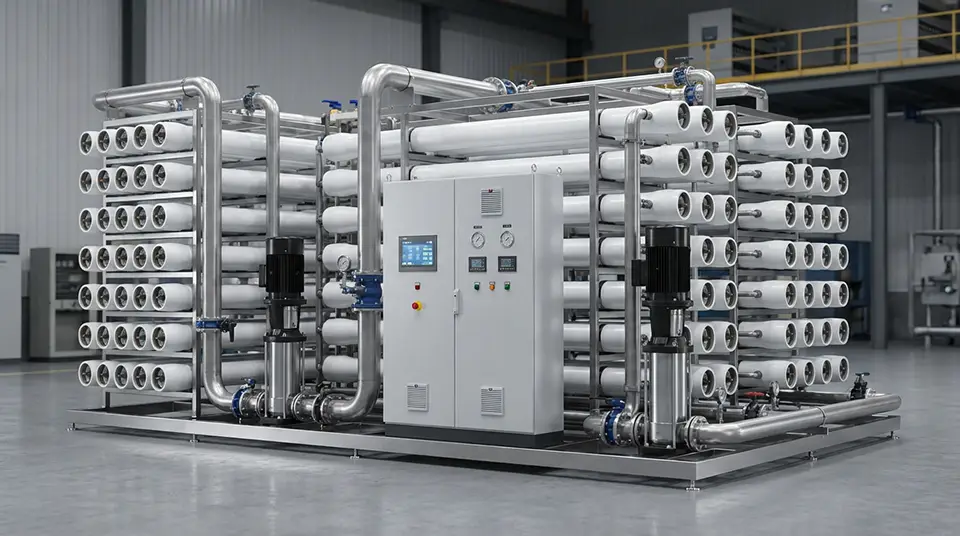
Maintaining peak performance in industrial water treatment systems requires a well-defined RO CIP procedure (Cleaning-in-Place). Over time, reverse osmosis (RO) membranes suffer from fouling and scaling, resulting in reduced permeate flux, increased differential pressure, and higher salt passage.
A proper membrane cleaning protocol not only restores system performance but also significantly extends membrane lifespan and reduces operating costs.
In this guide, SHANGHAI CM engineers break down the complete RO membrane cleaning process, including chemical selection, step-by-step procedures, and troubleshooting strategies.
1. When Should You Perform an RO CIP Procedure?
Delaying cleaning can cause irreversible membrane damage. You should initiate a CIP cleaning when any of the following conditions occur:
- Normalized permeate flux decreases by 10–15%
- Normalized feed pressure increases by 10–15%
- Salt passage increases by 10–15%
- Differential pressure (ΔP) increases by 15% or more
👉 These indicators suggest membrane fouling or scaling and require immediate action.
2. Types of RO Membrane Fouling and Cleaning Methods
Understanding fouling types is critical to selecting the correct membrane cleaning chemicals.
Common Fouling Types
| Fouling Type | Cause | Recommended Cleaning |
|---|---|---|
| Organic Fouling | Oils, humic substances | Alkaline cleaning (pH 10–12) |
| Biofouling | Bacteria, biofilm | Alkaline + biocide |
| Inorganic Scaling | CaCO₃, CaSO₄, BaSO₄ | Acid cleaning (pH 2–3) |
| Metal Fouling | Iron, manganese | Acid + reducing agent |
👉 Using the wrong chemical can worsen fouling or permanently damage the membrane.
3. Selecting the Right Membrane Cleaning Chemicals
Choosing the correct chemicals is the foundation of a successful RO CIP procedure.
Alkaline Cleaners (pH 10–12)
Used for:
- Organic fouling
- Biofouling
- Oil and grease removal
Acid Cleaners (pH 2–3)
Used for:
- Calcium carbonate scaling
- Metal oxides (iron fouling)
- Inorganic deposits
👉 Always follow membrane supplier guidelines for pH and temperature limits.
4. Standard Industrial RO CIP Procedure (Step-by-Step)
A structured CIP cleaning protocol ensures safe and effective membrane recovery.
Step 1: Preparation & Low-Flow Filling
- Replace system water with cleaning solution at low flow rate
- Prevent foulants from being pushed deeper into membrane channels
Step 2: Recirculation
- Circulate cleaning solution for 30–60 minutes
- Maintain temperature between 25–40°C
- Monitor pH and adjust if necessary
Step 3: Soaking
- Stop pump and soak membranes for 1–8 hours
- Helps dissolve stubborn foulants
Step 4: High-Flow Flushing
- Increase flow rate to create turbulence
- Duration: 20–30 minutes
- Removes loosened contaminants from membrane surface
Step 5: Final Rinse & Return to Service
- Flush with permeate or high-quality feed water
- Ensure no residual chemicals remain
- Discard initial permeate until quality stabilizes
5. Recommended CIP Operating Parameters
| Parameter | Recommended Range |
|---|---|
| Alkaline Cleaning pH | 10–12 |
| Acid Cleaning pH | 2–3 |
| Temperature | 25–40°C |
| Flow Velocity | 30–40 LPM per vessel |
| Pressure | < 4 bar (60 psi) |
👉 Staying within these limits prevents membrane damage and ensures optimal cleaning efficiency.
6. How Often Should RO Membranes Be Cleaned?
CIP frequency depends on feed water quality and system design:
- Standard systems: Every 3–6 months
- High fouling conditions: Every 1–3 months
- Poor pretreatment (high SDI): More frequent cleaning required
👉 Regular monitoring is more important than fixed schedules.
7. Common CIP Mistakes to Avoid
Based on field experience, avoid the following errors:
❌ Mixing Incompatible Chemicals
Never mix acidic and alkaline cleaners. Always flush thoroughly between stages.
❌ Excessive Pressure
CIP pressure must not exceed 4 bar (60 psi) to avoid membrane damage or telescoping.
❌ Ignoring pH & Temperature Limits
Exceeding limits can permanently damage the polyamide layer.
8. Why SHANGHAI CM CIP Systems Perform Better
At SHANGHAI CM, our systems are engineered using 3D CAD design to optimize CIP efficiency:
- Uniform flow distribution across membrane elements
- Minimized dead zones in piping design
- Improved cleaning efficiency
- Reduced chemical consumption
- Extended membrane lifespan
👉 This engineering advantage ensures every RO CIP procedure delivers maximum performance recovery.
9. Frequently Asked Questions (FAQ)
Q1: What is CIP in an RO system?
CIP (Cleaning-in-Place) is a process of cleaning RO membranes without removing them from the system.
Q2: How long does RO CIP take?
Typically 4–12 hours, depending on fouling severity.
Q3: What chemicals are used in RO cleaning?
Mainly alkaline cleaners, acid cleaners, and sometimes biocides or reducing agents.
Q4: Can RO membranes be cleaned without a CIP system?
It is not recommended. A dedicated CIP system ensures proper flow, temperature, and safety.
Q5: What happens if RO membranes are not cleaned?
Performance declines, energy costs increase, and membranes may require early replacement.
Q6: How do you identify membrane fouling?
By monitoring flux decline, pressure increase, and salt passage.
Q7: What is the best temperature for CIP cleaning?
Typically 25–40°C, depending on membrane tolerance.
Q8: How can I extend RO membrane lifespan?
Proper pretreatment, regular monitoring, and timely CIP cleaning are key.
Conclusion
A well-executed RO CIP procedure is essential for maintaining system efficiency and protecting your membrane investment. By selecting the right membrane cleaning chemicals and following a structured cleaning protocol, you can restore performance, reduce operating costs, and extend system lifespan.
Get Expert Support
Need help optimizing your RO cleaning process?
Get a FREE RO CIP Cleaning Plan & Chemical Recommendation from SHANGHAI CM engineers.
We provide:
- Customized CIP procedures
- Membrane cleaning chemical selection
- CIP system design & optimization
👉 Contact us today to improve your system performance.