
Choosing the right seawater reverse osmosis (SWRO) membrane is one of the most critical decisions in desalination system design. The membrane directly impacts water quality, energy consumption, operational stability, and long-term cost.
In real-world engineering projects, an incorrect membrane selection can lead to:
- 30–50% decline in system performance
- Frequent fouling and cleaning cycles
- Increased energy consumption
- Premature membrane replacement
This is not theoretical—many desalination projects fail to meet expectations simply because the membrane was selected based on price or brand, rather than actual operating conditions.
This guide provides a practical, engineering-based SWRO membrane selection framework, combining technical criteria with real project insights to help you choose the best solution.
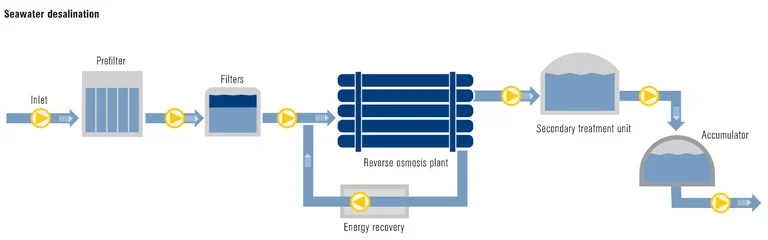
Quick Answer: How to Choose a Seawater RO Membrane
If you need a quick checklist, focus on these five factors:
- Salt rejection ≥ 99.5–99.8%
- Operating pressure and energy consumption balance
- Feed water quality and fouling risk
- Membrane lifespan and cleanability
- Total cost of ownership (TCO), not just purchase price
👉 The best membrane is not the most expensive one—it is the one that fits your system conditions.
1. Salt Rejection Requirements
Salt rejection is the primary performance indicator of an RO membrane. It determines whether the produced water meets the required quality standard.
Typical Requirements by Application
| Application | Target TDS | Recommended Rejection |
|---|---|---|
| Drinking water | < 500 mg/L | ≥ 99.7% |
| Industrial boiler | < 50 mg/L | ≥ 99.8% |
| Agriculture | < 1000 mg/L | ≥ 99.5% |
Higher salt rejection improves water quality but also comes with trade-offs.
Engineering Insight
Many engineers assume that higher rejection is always better. In reality:
- Higher rejection membranes usually require higher operating pressure
- This increases energy consumption
- It may also accelerate membrane fouling
👉 In several projects, selecting ultra-high rejection membranes resulted in higher operating costs without significant benefit.
The key is to match rejection performance with actual water quality requirements.
2. Operating Pressure vs Energy Consumption
Energy consumption is the largest operating cost in seawater desalination systems. Membrane selection directly influences system pressure requirements.
Typical Pressure Ranges
- 700–750 psi → lower energy consumption, larger membrane area required
- 800–850 psi → balanced performance (most common design range)
- 850–900 psi → higher output, higher energy cost
Energy Consumption
Typical SWRO systems operate at:
👉 2.8–3.8 kWh/m³
Practical Considerations
- Low-pressure membranes reduce energy consumption
- However, they may require more membrane elements
- High-pressure membranes increase output but also increase operating cost
👉 The optimal design is always a balance between CAPEX (membrane quantity) and OPEX (energy consumption).
3. Feed Water Quality & Fouling Resistance
Feed water quality is the most critical factor affecting membrane performance and lifespan.
Recommended Feed Water Conditions
- SDI < 3
- TOC < 2 mg/L
- Iron < 0.05 mg/L
- Free chlorine: 0 ppm
Common Fouling Types
- Organic fouling
- Biofouling
- Scaling (CaCO₃, BaSO₄, silica)
Real Project Insight
In one seawater desalination project in Southeast Asia, the system used a high-performance membrane but failed within 12 months. The root cause was:
👉 Inadequate pretreatment leading to biofouling
After upgrading pretreatment (UF system), membrane life extended to over 3 years.
👉 This highlights a key principle:
Membrane performance is only as good as the pretreatment system.
Related Systems
4. Membrane Lifespan & Maintenance
Membrane lifespan is a key factor in long-term cost and system stability.
Typical Lifespan
- Standard systems: 2–3 years
- Well-optimized systems: 3–5 years or longer
Key Influencing Factors
- Feed water quality
- Pretreatment effectiveness
- Operating pressure
- Cleaning frequency
Role of CIP (Cleaning in Place)
Regular cleaning can:
- Restore membrane performance
- Reduce fouling accumulation
- Extend lifespan by 30–50%
👉 Learn more:
Important Insight
Membranes do not fail suddenly—they degrade gradually.
Monitoring these indicators is critical:
- Permeate flow decline (>10–15%)
- Salt rejection decrease
- Increased pressure
5. Total Cost of Ownership (TCO)
Many buyers focus only on membrane price. This is one of the most common and costly mistakes.
Key Cost Components
- Energy consumption (largest share)
- Membrane replacement frequency
- Cleaning chemicals and labor
- System downtime
Engineering Reality
A low-cost membrane may:
- Require more frequent replacement
- Increase cleaning frequency
- Consume more energy
👉 Result: higher total cost over time
Key Principle
The cheapest membrane is often the most expensive in the long run.
SWRO Membrane Selection Checklist
Rejection ≥ 99.7%? ✔
Operating pressure acceptable? ✔
Compatible with feed water? ✔
Fouling resistance sufficient? ✔
Lifecycle cost optimized? ✔
👉 If any answer is “NO”, the membrane is not suitable.
Common Mistakes in Membrane Selection
Based on real project experience, the most common mistakes include:
- Choosing the lowest price without technical evaluation
- Ignoring seasonal changes in seawater quality
- Over-specifying membrane performance
- Underestimating fouling risks
- Not considering long-term operating cost
👉 These mistakes often lead to system instability and higher lifecycle costs.
Why Choose CM Seawater RO Membranes
CM provides high-performance SWRO membranes designed for real industrial applications, not just laboratory conditions.
Key Advantages
- Salt rejection up to 99.7%
- Optimized for high salinity seawater
- Strong anti-fouling performance
- Competitive pricing compared to Tier 1 brands
- Customizable solutions for different projects
👉 Explore more:
Typical Applications
CM SWRO membranes are widely used in:
- Seawater desalination plants
- Island and coastal water supply systems
- Offshore platforms
- Industrial water reuse projects
FAQ
What is the best RO membrane for seawater?
There is no universal “best” membrane. The optimal choice depends on water quality, system design, and cost considerations.
Is higher salt rejection always better?
No. Higher rejection increases operating pressure and energy consumption.
What pressure is required for seawater RO?
Typically 55–70 bar (800–1000 psi) depending on system design.
How can membrane fouling be reduced?
By using proper pretreatment systems and regular CIP cleaning.
Can membranes be customized?
Yes, many manufacturers (including CM) provide application-specific membrane solutions.
Conclusion
Selecting the best seawater RO membrane requires a balanced evaluation of:
- Salt rejection
- Energy consumption
- Fouling resistance
- Lifespan
- Total cost
By applying a systematic selection approach, engineers can significantly improve system performance and reduce long-term operating costs.
👉 For project-specific recommendations and customized solutions, contact our technical team.